Japanese vs German knives: how they differ and which to choose
The short answer. Japanese knives are usually made from harder steel, around 60 HRC or more, and ground thinner, so they cut more cleanly and stay sharp longer but can chip if twisted or used on bone. German knives are softer (about 56–58 HRC), heavier and tougher, so they shrug off rough handling and are easy to keep in line with a honing steel. Choose German for one tough, low-maintenance knife; choose Japanese if you mostly cut boneless food and will sharpen on a whetstone or use a sharpening service.
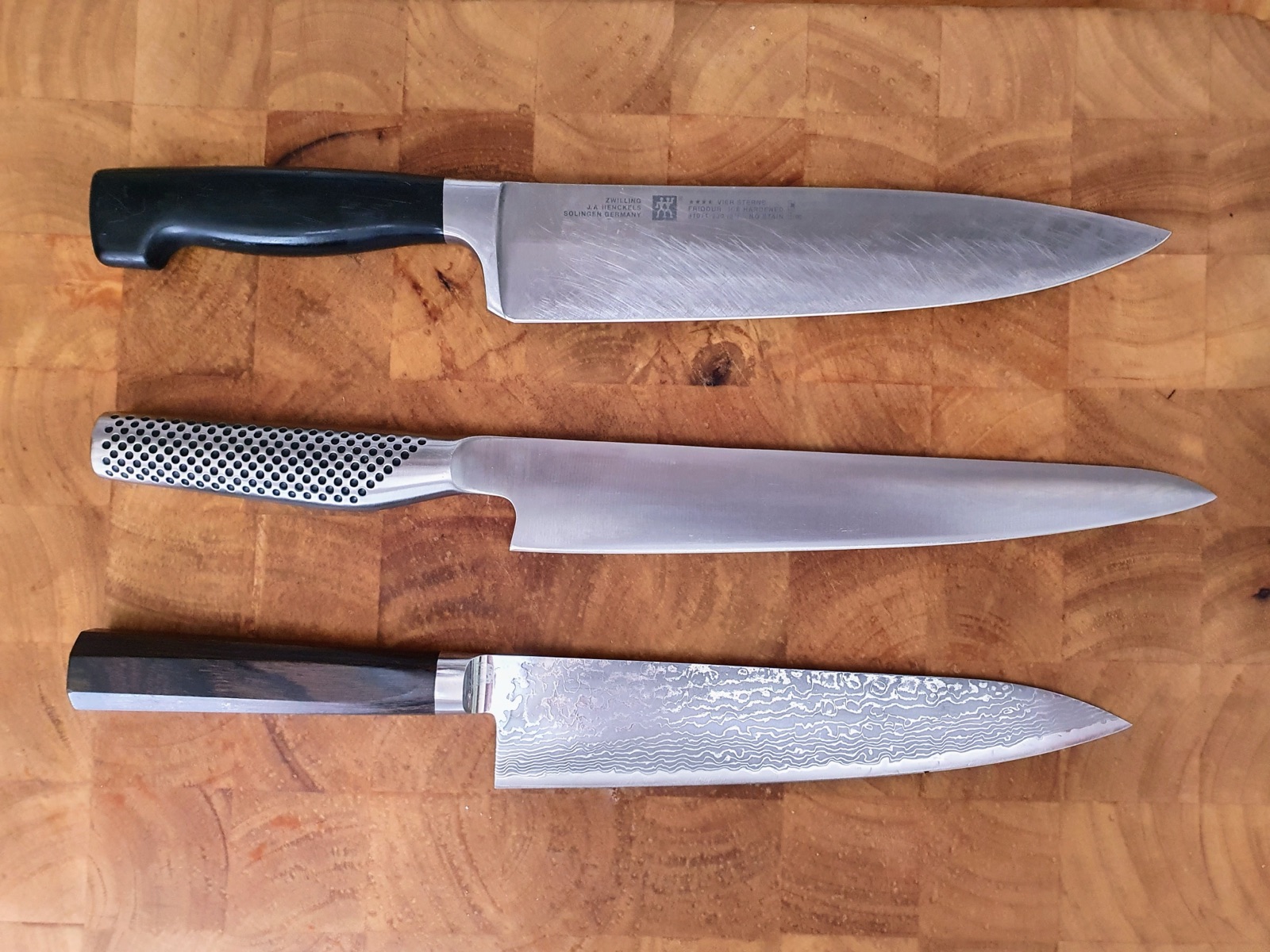

On this page 8 sections
The short version
The Japanese chef's knife is the gyuto. Here is how a typical one compares with a German chef's knife such as a Wüsthof Classic or Zwilling Professional S:
| Japanese (typical) | German (typical) | |
|---|---|---|
| Steel hardness | About 60 HRC and up | About 56–58 HRC |
| Edge angle per side | About 12–16° | About 14–15° (current Wüsthof, Zwilling); about 20° on older knives |
| Behind the edge | Thin | Thicker |
| 8-inch chef's knife weight | Often 6–7.5 oz | Often 8.5–9 oz |
| Profile | Flatter near the heel, suits push-cuts | Curved belly, suits rocking |
| Bolster | None, or a small collar that stops short of the edge | Often a full or half bolster |
| When it dulls | Tends to wear or chip | Tends to roll or bend |
| Upkeep | Whetstone, fine ceramic rod or strop | Honing steel, whetstone or sharpener |
These are tendencies, not rules. Global, the Japanese brand with the all-steel handles, is listed at 56–58 HRC, as soft as a German knife. German brands now sharpen as acutely as many Japanese ones, so the angle ranges overlap; check your own knife's spec. And price is no dividing line: the 8-inch Zwilling Professional S and Shun Classic chef's knives both typically sell for about $150–190 at US retailers.
Steel and hardness
Most German knives are made from a stainless steel called X50CrMoV15. The name describes the recipe: about 0.5% carbon and 15% chromium, plus small amounts of molybdenum and vanadium (the EN 10088-3 limits are 0.45–0.55% carbon and 14–15% chromium). It is usually hardened to about 56–58 on the Rockwell C scale (HRC). Zwilling quotes 57 HRC for its Professional S chef's knife, and retailers list 58 HRC for Wüsthof's Classic line.
Japanese chef's knives usually run harder, at about 60 HRC or more. Shun's Classic chef's knife, made in Seki with a VG-MAX stainless core, is listed at 60–61 HRC. Traditional Japanese carbon steels such as White #2 and Blue #2 are often hardened further still, and they rust if left wet; our guide to carbon vs stainless steel knives covers that choice.
Harder steel holds a fine edge longer before it needs sharpening. The cost is brittleness. When a soft German edge meets a bone or a twist of the wrist, it bends. A hard Japanese edge in the same spot is more likely to chip. Neither is a defect; they just fail in different ways, and that difference drives most of the care advice below.
Edge angle and thickness
The edge angle is how steeply each side is ground; a lower angle gives a thinner, keener edge. Japanese double-bevel knives (sharpened on both sides, as nearly all gyutos and santokus are) are commonly sharpened at about 12–16° per side. Shun's Classic line, for example, is listed at about 16° per side.
The German side has changed. For a long time about 20° per side was normal for Western knives. Wüsthof now says its laser-guided PEtec edge is 14.5° per side, and Zwilling's Professional S 8-inch chef's knife is listed at 15° per side, the angle Zwilling's own product pages give for the line. Those are as acute as many Japanese double-bevel knives, and more acute than the Shun. An older German knife, or one resharpened on a sharpener set to 20°, will have the wider edge.
So the angle alone no longer separates the two. What still does is the steel behind the edge. A Japanese blade is usually ground thinner just above the edge, and that is why it slides through carrots and sweet potatoes without wedging and cracking them. A thicker German blade pushes food apart more as it goes. To see what a given angle means on your own blade, try the sharpening angle tool.
Weight, balance and bolster
German chef's knives are usually forged with a full tang and a bolster: a thick collar of steel where the blade meets the handle. That adds weight and moves the balance back toward your hand. Zwilling's Professional S 8-inch chef's knife is listed at 8.5 oz, and retailers list Wüsthof's Classic 8-inch at about the same.
Japanese knives usually have no full bolster. Wa-handled knives have none, and Western-handled ones such as the Shun Classic have only a small metal collar that stops short of the edge. The handle is lighter too, so the balance sits farther forward. Shun's Classic 8-inch chef's knife is listed at about 7.5 oz, and knives with traditional wooden handles are often lighter still.
A full bolster has a practical side effect. Because it runs down to the heel, the stone can't reach the last bit of edge. As the edge is sharpened back over the years, the bolster starts to stick out below the edge line, the heel can't reach the board, and push-cuts leave food joined at the back. The fix is to grind the bolster down as well, which is one reason many newer German knives use a half (demi) bolster that stops short of the edge.
Weight itself is a matter of feel. A heavier knife does more of the work on dense vegetables. A lighter one tires your hand less over a long prep session and is easier to control on fine cuts.
Blade shape and handles
A German chef's knife has a pronounced curved belly that rises toward the tip. It is made for rocking: the tip stays on the board while the edge rolls through herbs and garlic. A gyuto is usually flatter near the heel, with a gentler curve toward the tip, so it favors push-cuts and tap-chopping, though most gyutos rock well enough.
German knives use a Western (yo) handle, usually riveted through a full tang. Japanese knives come with either a Western handle or a Japanese (wa) handle, a light round, octagonal or D-shaped wooden handle on a partial tang. D-shaped handles are made for one hand, so left-handed cooks should check before buying.
The edge itself can be handed too. German chef's knives are ground symmetrically. Some Japanese double-bevel knives are ground asymmetrically, with more of the bevel on the right side, which favors right-handed cooks; a sharpener can rebalance the edge over time, as our notes for left-handed cooks explain. If you are torn between a Japanese santoku and a Western chef's knife, our santoku vs chef's knife comparison goes through the shapes in detail.
Care and sharpening
German knives are easy to live with. Because the edge tends to roll rather than chip, a few light strokes on a honing steel push it back into line between sharpenings. When it finally needs sharpening, a whetstone, a guided sharpener or a professional service all work. To keep a current Wüsthof or Zwilling factory edge, sharpen at 14–15° per side; many pull-through and guided sharpeners are fixed at 20°, which suits older knives but widens a new one.
Japanese knives need gentler habits:
- Sharpen on a whetstone at a low, steady angle. Avoid pull-through sharpeners, which are often set wider than a Japanese edge and can chip hard steel.
- Skip the grooved steel rod from a German knife set.
- Keep them off bones, frozen food and hard squash rinds, and don't twist the blade to pry food apart.
- Use a wood or soft plastic board. Glass and stone boards chip thin edges.
- Hand wash and dry right away. That goes for every good knife, and it matters most with carbon steel.
Our guide to sharpening Japanese knives covers the method step by step.
Which should you choose?
Choose a German knife if you want one tough knife for everything, including jointing a chicken or splitting a squash, you like to rock-chop, or you would rather hone than sharpen.
Choose a Japanese knife if you mostly cut vegetables, fish and boneless meat, you like a light knife and a very sharp edge, and you are willing to use a whetstone or pay for sharpening a few times a year.
Skip a Japanese knife if it will be shared with people who use it on bones, leave it in the sink or put it in the dishwasher. A German knife tolerates that far better.
If you already own a German chef's knife, you don't have to replace it. Keep it for bones and squash, and add a gyuto for vegetables and fish.
Japanese vs German knife questions
Are Japanese knives sharper than German knives?
Usually, yes. Harder steel holds a keen edge longer, and a thinner grind behind the edge cuts with less wedging. Edge angle matters less than it used to: current Wüsthof and Zwilling edges (14.5–15° per side) are as acute as many Japanese double-bevel knives (about 12–16°).
Are German knives more durable?
They resist chipping better. Their softer, thicker steel bends rather than breaks, which makes them the safer choice for heavy or careless use. A bent edge is also quicker to fix than a chipped one.
Can you sharpen a Japanese knife like a German one?
Not quite. Sharpen on a whetstone at the knife's original angle, often 12–16° per side, with lighter pressure, and avoid grooved steels and pull-through sharpeners.
Which is better for a beginner?
If you're unsure, start with a German knife: it tolerates bones, twisting and a honing steel. If you already cut mostly boneless food, a stainless Japanese gyuto with a Western handle is the easier way in. It won't rust like carbon steel, but it will still chip if misused. Leave hard carbon-steel and wa-handled knives until you're comfortable sharpening on a whetstone.