Types of Japanese Knives: What Each One Is For
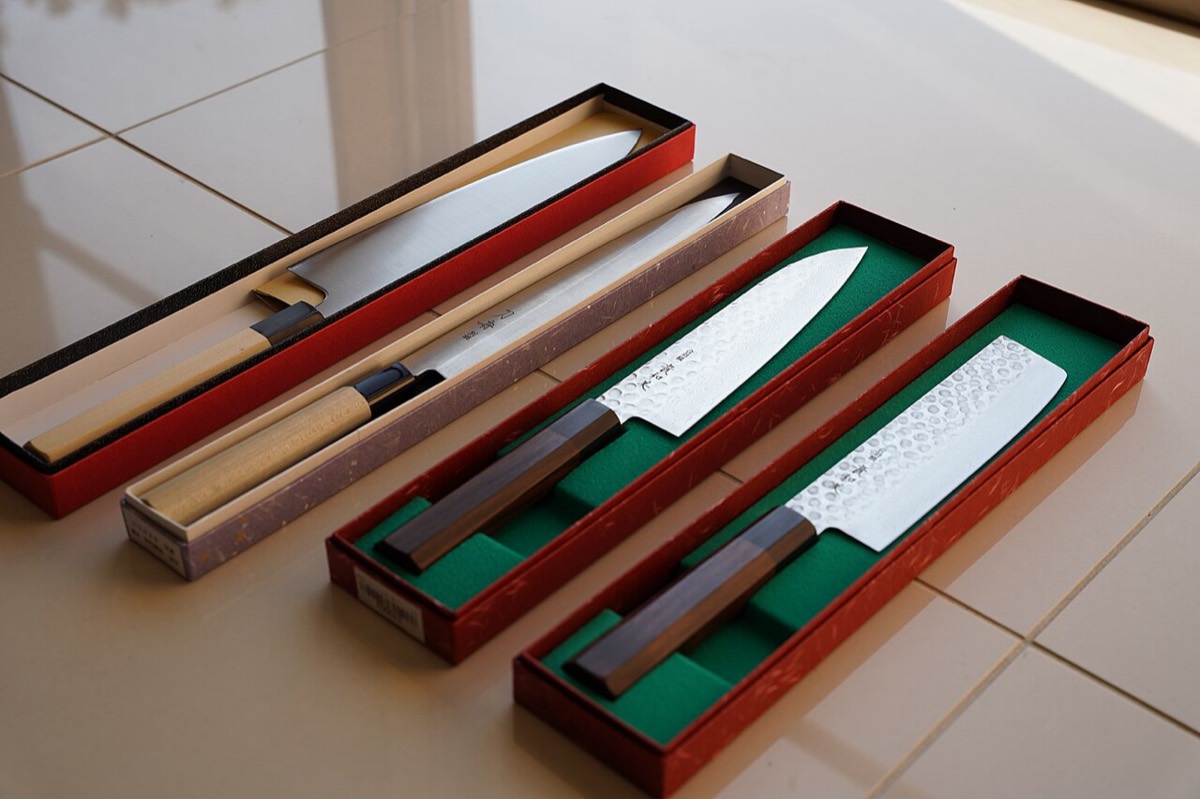
The short answer. Most home cooks need just two Japanese knives: an all-rounder (a gyuto or a santoku) and a small petty knife for detail work. The other ten types here are specialists for vegetables, fish, poultry or slicing, and they're worth buying only once you know you'll use them.

On this page 6 sections
| Knife | Best for | Typical blade | Bevel | First knife? |
|---|---|---|---|---|
| Gyuto | almost everything: vegetables, meat, boneless fish | 180–270 mm | double | Yes |
| Santoku | vegetables, boneless meat and fish, in a small kitchen | 165–180 mm | double | Yes |
| Nakiri | vegetables, push-cutting and fine slicing | 165–180 mm | double | Yes |
| Bunka | vegetables and boneless proteins, with a sharp tip for detail work | 165–180 mm | double | Yes |
| Petty | small jobs: shallots, herbs, fruit, trimming meat | 120–150 mm | double | Yes |
| Sujihiki | slicing cooked meat, roasts and boneless fish in one stroke | 240–300 mm | double | No |
| Kiritsuke | push-cutting vegetables and slicing; the double-bevel version works as a gyuto | 210–270 mm | single or double | No |
| Yanagiba | slicing raw fish for sashimi and sushi in one long pull | 240–330 mm | single | No |
| Deba | breaking down whole fish: heads, collars, filleting | 150–210 mm | single | No |
| Usuba | precise vegetable work such as katsuramuki (paper-thin sheets) | 165–210 mm | single | No |
| Honesuki | breaking down chicken and other poultry at the joints | 135–165 mm | single or asymmetric double | No |
| Pankiri | crusty bread, soft cakes and tomatoes | 210–270 mm | double (serrated) | Yes |
Blade lengths are the usual range. Each knife below is drawn to scale from the most common size.
Everyday knives
These five are double bevel (sharpened on both sides), so they work in either hand and sharpen like any other kitchen knife.
Gyuto (牛刀): the Japanese chef's knife
Gyuto Drawn to scale
The gyuto is the Japanese take on the Western chef's knife: a curved belly for rocking, a pointed tip and a long edge, usually 210 mm. It is thinner and harder than a German chef's knife, so it slices more cleanly and holds an edge longer. If you want one knife that does everything, this is it. Gyuto guide.
Santoku (三徳): the all-purpose home knife
Santoku Drawn to scale
Shorter than a gyuto, with a flatter edge and a rounded tip that curves down from the spine. Built for push-cuts and straight chops rather than rocking, and comfortable on a small board. The most popular Japanese knife outside Japan. Santoku guide.
Nakiri (菜切): the vegetable knife
Nakiri Drawn to scale
A tall, rectangular blade with a dead-flat edge. The whole edge meets the board at once, so it slices through carrots, onions and cabbage without leaving connected pieces. It has no point, so it's a poor choice for meat or detail work. Nakiri guide.
Bunka (文化): the santoku with a sharp tip
Bunka Drawn to scale
Similar in size to a santoku, but the spine drops in a straight line to an angled point (often called a k-tip or reverse tanto). That tip is good for scoring, fine mincing and getting into tight spots. Bunka guide.
Petty (ペティ): the small utility knife
Petty Drawn to scale
A 120–150 mm knife for jobs too small for your main knife: shallots, garlic, strawberries, trimming silver skin. Somewhere between a paring knife and a small chef's knife, and the best second knife you can buy. Petty knife guide.
Specialist knives
Several of these are traditionally single bevel: sharpened on one side only, with a flat or slightly hollow back. That gives an extremely keen, precise edge, but it steers when you cut, takes practice to sharpen, and is made for one hand. Left-handed cooks need a left-handed version.
Yanagiba (柳刃): the sushi knife
Yanagiba Drawn to scale
A long (240–330 mm), narrow, single-bevel slicer. It cuts raw fish for sashimi in one long pulling stroke, so the surface stays glossy instead of torn. Only worth owning if you prepare raw fish. Yanagiba guide.
Deba (出刃): the fish butchery knife
Deba Drawn to scale
A thick, heavy, single-bevel knife for breaking down whole fish: taking off heads, cutting through small bones and filleting. The spine can be 6–9 mm thick. It isn't a cleaver, so don't use it on large meat bones.
Usuba (薄刃): the traditional vegetable knife
Usuba Drawn to scale
The professional, single-bevel ancestor of the nakiri. It is used for precise vegetable work such as katsuramuki, turning a daikon into one paper-thin sheet. For home vegetable prep, a nakiri does the same job and is far easier to use and sharpen.
Sujihiki (筋引): the slicing knife
Sujihiki Drawn to scale
A long, narrow, double-bevel slicer, like a Western carving knife but thinner. Use it for roasts, brisket, ham and boneless fish, anywhere you want one clean stroke instead of sawing.
Kiritsuke (切付): the angled-tip slicer
Kiritsuke Drawn to scale
A long, flat blade with a steep angled tip. The traditional single-bevel kiritsuke is a hybrid of a yanagiba and an usuba, used by head chefs. Most kiritsukes sold in the US are double-bevel "kiritsuke-style" gyutos, which work fine as an all-rounder if you push-cut rather than rock.
Honesuki (骨スキ): the poultry boning knife
Honesuki Drawn to scale
A stiff, triangular boning knife for taking chickens and ducks apart at the joints. The tall heel gives you knuckle room and lets you lean on the blade to snap through cartilage.
Pankiri (パン切): the bread knife
Pankiri Drawn to scale
A long serrated knife for crusty bread, soft cakes and tomatoes. Japanese bread knives tend to be thinner and lighter than Western ones. Serrations can't be sharpened on a flat whetstone, so you'll need a ceramic rod for this one.
Single bevel vs double bevel
A double-bevel edge is ground on both sides of the blade, usually symmetrically. It cuts straight, works for left and right hands, and you sharpen both sides the same way. All everyday Japanese knives sold abroad are double bevel.
A single-bevel edge is ground on one side only. The other side is flat with a slight hollow (urasuki), which reduces sticking. The edge can be thinner and sharper, but it pulls to one side as you cut and you sharpen the two sides differently. See how to sharpen Japanese knives for both kinds.
Which two knives to start with
Pick the main knife by how you cook, then add a petty knife:
- You cook a bit of everything and like to rock-chop: 210 mm gyuto + 135–150 mm petty.
- You like a compact knife and push-cut, or have a small board: 165–180 mm santoku or bunka + petty.
- You cook mostly vegetables: 165 mm nakiri + petty. Add a gyuto later for meat.
- You prepare raw fish often: any of the above, then a 270 mm yanagiba once you know you'll keep at it.
Carbon or stainless?
Japanese knives come in stainless steel (VG-10, AUS-10, SG2 and similar), carbon steel (aogami "blue" and shirogami "white" paper steels), or carbon steel clad in stainless. Carbon steel takes a keener edge and is easier to sharpen, but rusts if left wet. Stainless is the easy choice for a first knife. Clad knives give you a carbon edge with less maintenance.
Common questions
What is the most famous Japanese knife?
Outside Japan, the santoku is the best known. Inside Japan, the gyuto is the standard professional all-rounder, and the yanagiba is the iconic sushi chef's knife.
Do I need a nakiri if I have a santoku?
No. A santoku already handles vegetables well. A nakiri is worth it only if you cut lots of vegetables and enjoy push-cutting with a totally flat edge. See santoku vs nakiri.
Can left-handed cooks use Japanese knives?
Yes. Double-bevel knives work in either hand. Single-bevel knives (yanagiba, deba, usuba, traditional kiritsuke) must be bought in a left-handed version, which usually costs more and takes longer to order.
Where are Japanese knives made?
Most come from a few historic blade towns: Sakai (Osaka), Seki (Gifu), Echizen (Fukui), Tosa (Kochi) and Sanjo (Niigata). Sakai is especially known for single-bevel knives used by professional chefs. Read the history of knife making in Sakai.