Nakiri Knife: What It Is Used For and How to Choose One
The short answer. A nakiri is a Japanese vegetable knife with a tall, rectangular blade, a completely flat edge and a square tip, usually 165–180 mm long. It is made for push-cutting and chopping vegetables straight down to the board, which gives clean, even slices with no accordion cuts where the edge failed to reach.
Author Name and photo pending
Testing status: Not tested yet We haven't tested a knife for this page. The numbers are typical ranges and makers' specs, and each one is marked.

On this page 10 sections
What is a nakiri knife?
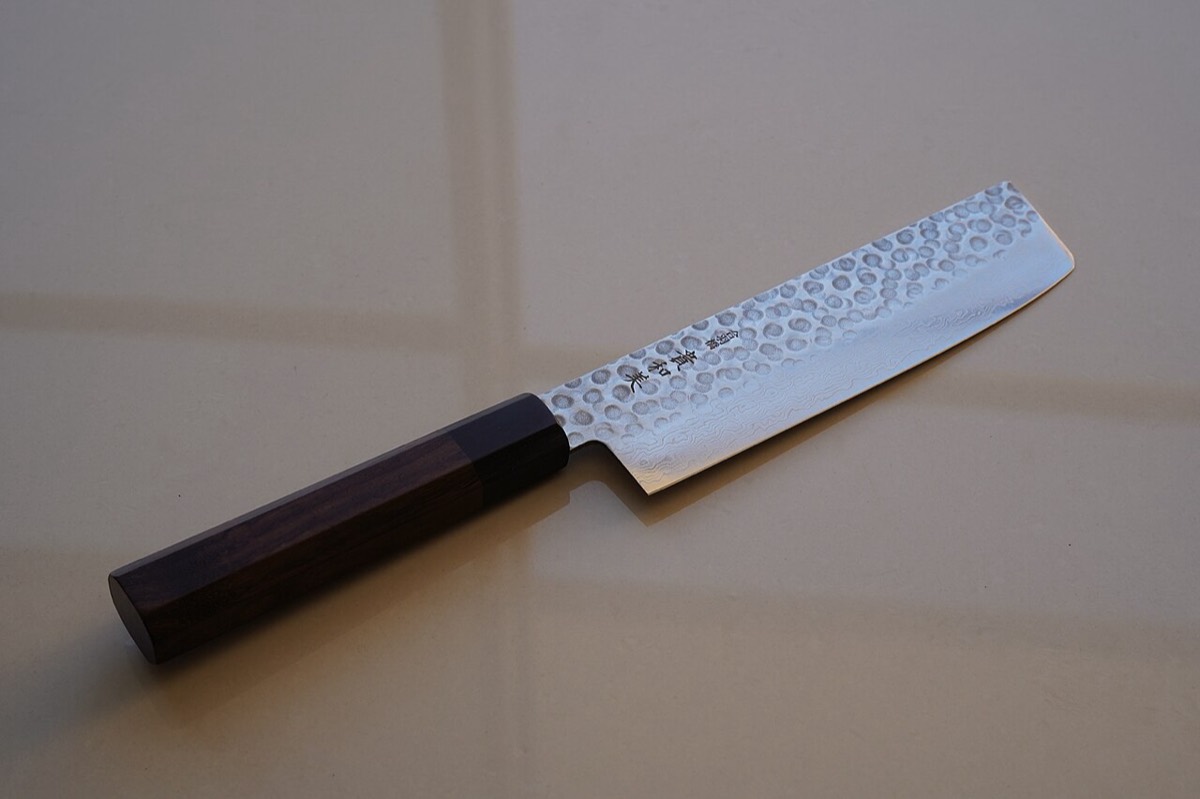
A nakiri is a double-bevel Japanese knife designed only for vegetables. Its flat edge meets the board along its whole length, and its square front end has no real point. It is the home cook's version of the traditional vegetable knife, easier to use and sharpen than the professional usuba.
Nakiri (菜切) means roughly "greens cutter". For much of the 20th century it was a standard knife in Japanese homes, where vegetables made up most of the daily cutting. The santoku later borrowed its tall, flat blade and added a tip.
Nakiri Drawn to scale
What defines the shape:
- Dead-flat edge. No belly, so every chop makes full contact with the board.
- Tall blade. About 50 mm at the heel, which leaves knuckle room and works as a scoop for moving chopped food.
- Square or slightly rounded tip. Safe and blunt-ended. It can't do pointy work such as scoring an onion or deveining shrimp.
What is a nakiri knife used for?
A nakiri knife is used for slicing, dicing, julienning and chopping vegetables. It is at its best on long, firm or leafy produce: cabbage, carrots, cucumbers, leeks, scallions, daikon and herbs. The flat edge cuts all the way through with each stroke, so slices separate cleanly instead of hanging together.
- Shredding cabbage and lettuce
- Julienne and matchsticks of carrot, daikon and cucumber
- Thin, even slices of onion, scallion and leek
- Chopping herbs and greens such as spinach and kale
- Peeling with the heel section, and scooping prep into a pan with the tall blade
Common nakiri knife use stops at vegetables and soft fruit. Hard winter squash and big sweet potatoes are possible with care, but don't twist the blade to crack them open.
How to use a nakiri: the push-cut
The main nakiri technique is the push-cut: start with the edge resting on the food, then move the knife forward and down in one smooth stroke until the whole edge reaches the board. Lift, move back, repeat. You can also chop straight down for soft vegetables. What you can't do well is rock, because there is no curve to rock on.
- Pinch the blade just ahead of the handle and curl the fingers of your guiding hand.
- Place the front half of the edge on the food, angled slightly downward.
- Push forward and down together, letting the length of the edge do the work.
- Finish with the edge flat on the board, then lift and reset.
The tall blade rides against your knuckles as a guide, which makes even, thin slices easier than with a narrow chef's knife.
Nakiri vs santoku
A nakiri is a pure vegetable knife with a flat edge and square tip. A santoku keeps the flat edge and tall blade but adds a rounded tip, so it can also handle boneless meat, fish and small tip work. If you want one all-round knife, get a santoku. If you already have a chef's knife and cook a lot of vegetables, a nakiri is the better partner.
Nakiri and Santoku Drawn to scale
The two are close in length and height, so the choice is mostly about the tip and what else you cut. We go into it in santoku vs nakiri, and the santoku page covers that knife in full.
Nakiri vs usuba
A nakiri is double bevel, ground on both sides, and made for home cooks. An usuba is the professional vegetable knife: single bevel, heavier, usually taller, and built for precise techniques such as katsuramuki, peeling a daikon into a long paper-thin sheet. An usuba needs more skill to use and sharpen. For home cooking, a nakiri is the practical choice.
- Bevel. Nakiri: double, works in either hand. Usuba: single, so it is right- or left-handed.
- Use. Nakiri: everyday slicing and chopping. Usuba: decorative and precision cuts in Japanese cuisine.
- Sharpening. Nakiri: like any double-bevel knife. Usuba: the flat back and single bevel need careful single-bevel technique.
Read more about single-bevel knives on the usuba and the bevel explainer.
What size nakiri should you buy?
Get a 165 mm nakiri (about 6.5 inches). It is the most common size, long enough to cross a head of cabbage in a stroke or two and compact enough for a small board. A 180 mm nakiri covers more ground and suits cooks who prep large amounts of vegetables at once.
Weight varies more than length. Thin, light nakiris glide through dense vegetables; heavier ones chop with more momentum. Neither is wrong, but a thin blade behind the edge matters more than the number on the box.
Is a nakiri good for meat?
Not really. A nakiri can slice soft boneless meat, but its square tip can't trim fat or silverskin, and its tall, flat blade is awkward for long slicing strokes. Never use it on bones or frozen food: the thin edge will chip. Keep a gyuto, santoku or petty for meat.
How to sharpen a nakiri
A nakiri is double bevel, usually sharpened at about 12–15° per side, and its flat edge makes it one of the easier knives to sharpen. Use a 1000 grit stone to set the edge and a 3000–6000 grit stone to refine it. The main goal is keeping the edge perfectly flat from heel to tip.
Work the edge in two or three sections, with even pressure on each, so you don't wear a dip into the middle. A dip shows up as a gap of light between the edge and the board, and the knife will stop cutting cleanly through. Check by standing the knife on the board now and then. At 15° on a 50 mm-tall nakiri, the spine sits about 13 mm above the stone; the angle tool will work it out, and the whetstone guide has the full steps.
Which nakiri to buy
We're testing nakiris at three budgets: under $100, $100–200 and above. Each one gets weighed and measured, then used for a month of vegetable prep before it goes on this list.
Tojiro DP Nakiri 165mm
On our list, not tested yet. No recommendation until we have used it.
- Price
- under $100 (typical range)
We measuredMaker's specTypical range
Nakiri questions
Is a nakiri knife worth it?
Yes, if you cook a lot of vegetables and already own a chef's knife or santoku for everything else. If you can only buy one knife, get a santoku or gyuto instead.
Can you cut meat with a nakiri?
You can slice soft boneless meat, but it isn't designed for it. Keep it away from bones and frozen food.
Can you rock-chop with a nakiri?
No. The edge is flat, so rocking lifts most of it off the board. Push-cut or chop straight down.
Is a nakiri good for left-handed cooks?
Yes. Nakiris are double bevel and work in either hand. The single-bevel usuba is the one to buy in a handed version.
Nakiri or santoku for a first Japanese knife?
A santoku. It does most of what a nakiri does and handles meat and fish too. See santoku vs nakiri.