Santoku knife: uses, sizes & buying advice
The short answer. A santoku is a Japanese all-purpose knife, usually 165–180 mm long, with a flat edge and a rounded tip. It's built for push-cutting vegetables and boneless meat, which makes it a good first knife.
Author Name and photo pending
Testing status: Not tested yet We haven't tested a knife for this page. The numbers are typical ranges and makers' specs, and each one is marked.

On this page 9 sections
What is a santoku knife?
Santoku (三徳) means "three virtues". The usual reading is that it handles the three main jobs of a home kitchen: vegetables, meat and fish. Others read the three virtues as slicing, dicing and mincing. Either way the point is the same: one knife for most everyday cutting.
The shape came about in Japan in the mid-20th century as home cooking changed. It took the tall, flat blade of the traditional vegetable knife (nakiri) and added a usable tip, so a home cook could do most jobs with one knife instead of three.
Santoku Drawn to scale
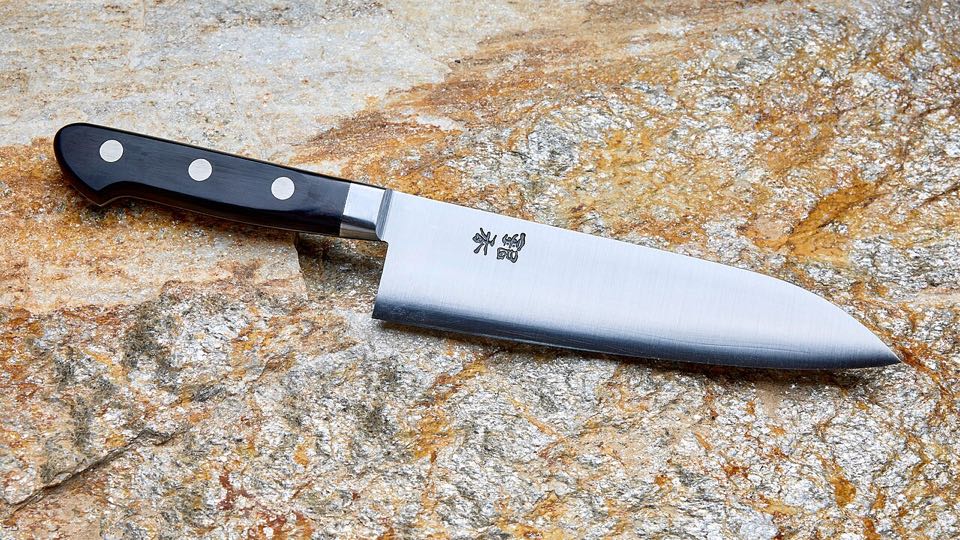
Santoku, 170 mm blade, about 46 mm tall at the heel (typical size, not a measured knife).
Three things set its shape apart:
- Flat edge. Most of the edge touches the board at once, so it slices cleanly with a push or a straight chop, but it doesn't rock like a Western chef's knife.
- Sheepsfoot tip. The spine curves down to the tip. The tip is less pointy than a gyuto's and harder to stab into things by accident, but it still does fine work.
- Tall, short blade. At about 46 mm high and 170 mm long, there's room for your knuckles above the board and the knife stays nimble on a small cutting board.
What is a santoku knife used for?
A santoku is at its best on anything you cut with a straight downward or forward stroke:
- Slicing and dicing onions, carrots, peppers, cucumbers and potatoes
- Shredding cabbage and fine-slicing scallions
- Mincing garlic, ginger and herbs (with a push-and-lift motion, not a rock)
- Slicing boneless chicken, pork and beef, and portioning fish fillets
- Scooping food off the board with the tall blade
It isn't the right tool for bones, frozen food, hard squash rinds you have to lever through, or carving a large roast in one long stroke. Use a cleaver, a heavier Western knife or a long slicer (sujihiki) for those.
Santoku vs chef's knife
The choice comes down to how you cut. A Western chef's knife (or a Japanese gyuto) has a curved belly that lets you rock the blade through herbs and garlic. A santoku's flat edge rewards push-cuts and straight chops instead. The santoku is also shorter, so it's easier to control and fits a small board, but it covers less ground on a big pile of vegetables or a watermelon.
Santoku and Gyuto Drawn to scale
Pick a santoku if you like short, controlled cuts and a compact knife. Pick a gyuto if you rock-chop or want one knife that can also slice large pieces. We compare them in detail in santoku vs chef's knife.
What size santoku should you buy?
Most santokus are 165–180 mm (6.5–7 inches), and that's the size to get. It is long enough to slice an onion in one stroke and short enough for a small board. The 130–150 mm (5–6 inch) "ko-santoku" is handy as a second knife or for small hands, but it gets crowded with larger vegetables.
Do you need a hollow (granton) edge?
Many santokus have scallops ground into the side of the blade, sold as reducing sticking. They help a little with wet, starchy food such as potatoes, but a thin blade with a good grind matters much more. Don't pay extra for scallops, and don't avoid a good knife because it has them.
Steel and handle
Most santokus sold in the US are stainless or stainless-clad, which is the right choice for a first Japanese knife: they hold an edge well and forgive a wet board. Carbon steel ("aogami", "shirogami") gets sharper and is easier to sharpen, but it rusts if you leave it wet and develops a patina.
Handles come in two styles. A Western (yo) handle has rivets and a bolster and feels like a German knife. A Japanese (wa) handle is a light, octagonal or D-shaped wooden handle that moves the balance toward the blade. Neither is better; it's a matter of feel.
How to sharpen a santoku
Most Japanese santokus are double bevel and come sharpened at about 12–15° per side, finer than the 20° of a typical German knife. Sharpen them on a whetstone: a 1000 grit stone to set the edge, then a finer 3000–6000 grit stone to refine it. Keep the angle steady and work until you can feel a small burr along the whole edge before switching sides.
Use the angle tool to see how high to lift the spine (about 12 mm for a 46 mm-tall santoku at 15°), and the full whetstone guide for the steps. Avoid pull-through sharpeners set to 20°: they'll make the edge thicker than it was designed to be.
Which santoku to buy
We plan to test santokus at three budgets: under $100, $100–200 and above. Each one will be weighed and measured, then used in everyday cooking for a month before we recommend it here. So far there is one candidate on the list, and it hasn't been tested yet:
Global G-48 Santoku 18cm
On our list, not tested yet. No recommendation until we have used it.
- Price
- $100–150 (typical range)
We measuredMaker's specTypical range
Santoku questions
Is a santoku good for meat?
Yes, for boneless meat. It slices chicken breast, pork loin and steak cleanly. It is not for cutting through bone or joints.
Can you rock a santoku?
Only a little. The flat edge has almost no belly, so a rocking motion lifts most of the edge off the board. Push-cut or chop straight down instead.
Is a santoku good for left-handed cooks?
Yes. Almost all santokus are double bevel and work the same in either hand. Check the handle: a D-shaped wa handle can be made for right hands only, but octagonal and Western handles are neutral.
What is the difference between a santoku and a nakiri?
A nakiri is a vegetable knife with a completely flat edge and a square tip; a santoku has a usable tip and handles meat and fish too. See santoku vs nakiri.