Bunka Knife: What It Is For and How It Compares
The short answer. A bunka is a Japanese all-purpose knife, usually 165–180 mm long, with a flat edge, a tall blade and a sharply angled "k-tip". It does the same everyday cutting as a santoku, vegetables and boneless meat and fish, but its pointed tip is better for fine work such as scoring onions and trimming.
Author Name and photo pending
Testing status: Not tested yet We haven't tested a knife for this page. The numbers are typical ranges and makers' specs, and each one is marked.

On this page 10 sections
What is a bunka knife?
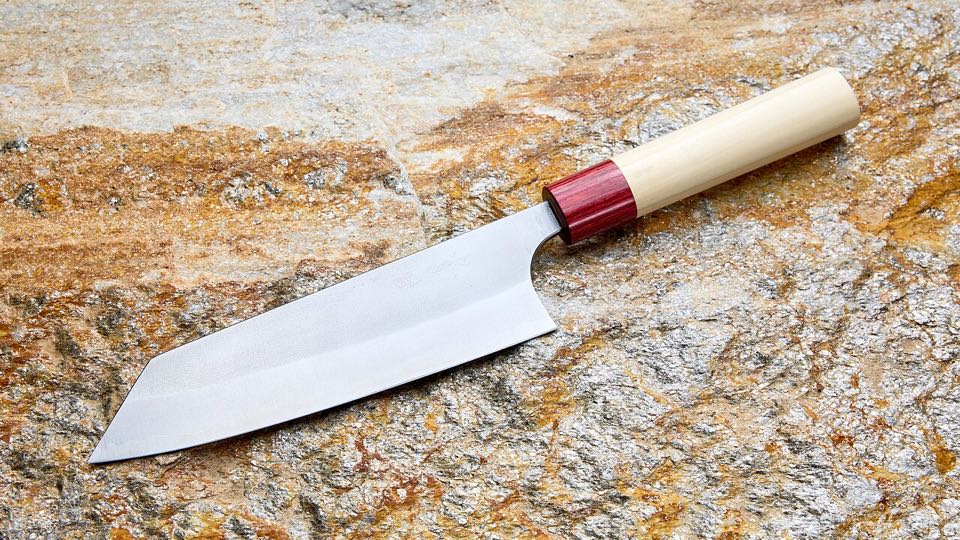
A bunka is a double-bevel, general-purpose Japanese knife with the length and height of a santoku but a different tip. The spine drops at a sharp angle to meet the edge in a fine point, a shape often called a k-tip or reverse tanto. It is a home cook's knife, not a specialist one.
Bunka (文化) means "culture". It is usually translated as "culture knife". The bunka is generally dated to the same mid-20th-century period as the santoku, as one of the all-purpose shapes made for Japanese home kitchens.
Bunka Drawn to scale
- Flat edge. Like a santoku or nakiri, most of the edge meets the board at once, which suits push-cuts and straight chops.
- Tall blade. About 48 mm at the heel, with knuckle clearance and room to scoop food off the board.
- K-tip. The angled front end gives a fine, strong point for detail work, and is the bunka's main point of difference.
What is a bunka knife used for?
A bunka knife is used for everyday prep: slicing and dicing vegetables, mincing herbs and garlic, and slicing boneless meat and fish. Its pointed k-tip adds precision work a santoku does less well: scoring onions before dicing, fine brunoise, trimming fat, and cutting into tight spots like the stem of a pepper.
- Onions, carrots, celery, peppers and other everyday vegetables
- Shallot and onion dice, using the tip for the horizontal and vertical scoring cuts
- Garlic, ginger and herbs with a push-and-lift motion
- Boneless chicken, pork and fish fillets
- Tip work: coring tomatoes, trimming silverskin, cutting into small spaces
Like other thin Japanese knives, it isn't for bones, frozen food or prying apart hard squash.
Bunka vs santoku
A bunka and a santoku share the same length, height and flat edge, so they cut most food the same way. The difference is the tip. A santoku has a rounded sheepsfoot tip that is forgiving and hard to stab with. A bunka has an angled, pointed k-tip that is better for precise work but more fragile and easier to catch on the board.
Bunka and Santoku Drawn to scale
- Pick a bunka if you do a lot of fine dicing, like using the tip, and want a bit more precision from a compact knife.
- Pick a santoku if you want the most forgiving shape for a first Japanese knife, or you share the knife with others.
For the santoku in full, see the santoku page.
Bunka vs gyuto
A gyuto is longer, usually 210–240 mm against a bunka's 165–180 mm, and has a curved belly you can rock. A bunka is shorter, flatter and a little taller, which suits push-cuts and a small board. Both have a pointed tip. Choose a gyuto if you rock-chop or cook in volume; choose a bunka if you prefer a compact knife.
Gyuto and Bunka Drawn to scale
The gyuto's extra length helps on big jobs such as cabbage, melon and slicing a roast. The bunka's flat edge and compact length make it quicker and easier to control on everyday vegetable prep. See the gyuto page for that knife's sizes and handles.
What is a ko-bunka?
A ko-bunka is a smaller bunka. "Ko" means small, and ko-bunka blades are typically around 130–150 mm, roughly between a petty knife and a full-size bunka. It keeps the tall, flat blade and k-tip in a shorter form, which makes it a good second knife or a main knife for small hands and small boards.
A ko-bunka is handy for shallots, garlic, herbs and quick jobs, with more knuckle clearance than a petty knife. It gets crowded with large vegetables, so it works best alongside a full-size main knife.
Who should buy a bunka?
A bunka suits cooks who like a compact, flat-edged knife and want a pointed tip for precision. It is a good first Japanese knife if you push-cut and don't rock, and a good partner for a longer gyuto. Skip it if you want the most forgiving tip, or if you mainly rock-chop.
If you mostly cut vegetables and never use a tip, a nakiri is simpler. If you want one knife for everything including large jobs, a gyuto is the safer pick. The bunka sits between them: flat like a nakiri, pointed like a gyuto, compact like a santoku.
Steel and handle
Bunkas are made in both stainless and carbon steel, often clad, and with either Western (yo) or Japanese (wa) handles. For a first knife, stainless or stainless-clad is the easiest to live with. Many bunkas are sold with a dark, rough forge finish (kurouchi) near the spine; it is a look, and it doesn't change how the knife cuts.
How to sharpen a bunka, including the tip
A bunka is double bevel, usually sharpened at about 12–15° per side, and its flat main edge sharpens like a santoku's. The k-tip needs extra care. Sharpen it as a separate section, turning the knife so the angled edge lies along the stone, and use light pressure so you don't round the point off.
- Sharpen the flat main edge in two or three sections on a 1000 grit stone, raising a burr along each.
- Rotate the knife so the angled tip section runs along the stone, keeping the same angle, and work it with light strokes until a burr forms right to the point.
- Repeat on the other side, then refine everything on a 3000–6000 grit stone.
At 15° on a 48 mm-tall bunka, the spine sits about 12 mm above the stone; the angle tool works it out for your knife. The point is the first thing to wear blunt or get rounded by a heavy hand, so check it under a light after each session. The whetstone guide has the full steps.
Which bunka to buy
We're testing bunkas at three budgets: under $100, $100–200 and above. Each one gets weighed and measured, then used for a month of everyday cooking before it goes on this list.
Bunka questions
Is a bunka better than a santoku?
Neither is better. A bunka's pointed tip is more precise; a santoku's rounded tip is more forgiving. Everything else is close to the same.
Is a bunka good for beginners?
Yes, if you push-cut. The flat edge is easy to use and sharpen. Just be gentle with the tip, which can chip if it hits the board hard.
Can you rock-chop with a bunka?
Only a little. The edge is mostly flat, so a rocking motion lifts much of it off the board. Push-cut or chop straight down.
Is a bunka good for meat?
Yes, for boneless meat. The tip is useful for trimming fat and silverskin. Keep it off bones.
What does k-tip mean?
It describes the angled tip where the spine drops sharply to meet the edge, similar to the tip of a kiritsuke. It is also called a reverse tanto tip.
Is a bunka good for left-handed cooks?
Yes. Bunkas are double bevel and work in either hand. Check that a wa handle isn't D-shaped for the right hand.