Gyuto Knife: The Japanese Chef's Knife Explained
The short answer. A gyuto is the Japanese version of the Western chef's knife: a double-bevel, all-purpose blade, usually 210–240 mm long, with a pointed tip and a gently curved edge. It is thinner, harder and lighter than a typical German chef's knife, so it cuts with less effort and holds a sharp edge longer.
Author Name and photo pending
Testing status: Not tested yet We haven't tested a knife for this page. The numbers are typical ranges and makers' specs, and each one is marked.

On this page 10 sections
What is a gyuto knife?
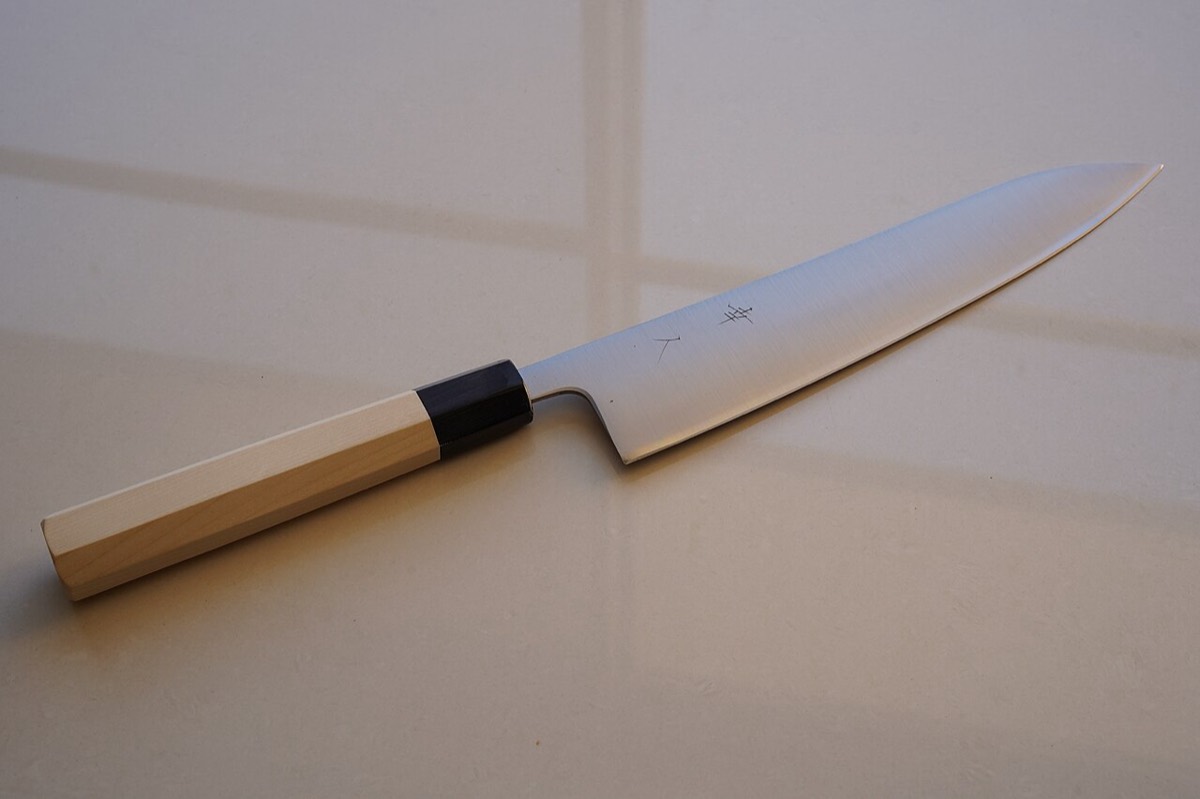
A gyuto is a general-purpose Japanese kitchen knife built on the outline of the Western chef's knife. It handles vegetables, boneless meat and fish, and most everyday prep. If you want one Japanese knife that does nearly everything, a gyuto kitchen knife is the usual answer.
Gyuto (牛刀) translates roughly as "beef sword". Japanese makers adopted the Western chef's knife as Western cooking, and meat, became common in Japan from the late 1800s, then made it in their own way: thinner behind the edge, in harder steel, with a flatter profile than the German knives it came from.
Gyuto Drawn to scale
Its shape has three working parts:
- Pointed tip. Narrow and sharp, for scoring onions, trimming silverskin and fine work near the board.
- Curved belly. Lets you rock the knife through herbs and garlic, though the curve is usually gentler than on a German knife.
- Flatter heel section. The rear third of the edge sits close to the board, so push-cuts and chops make full contact.
What is a gyuto used for?
A gyuto is used for almost every cutting job in a home kitchen: slicing and dicing vegetables, mincing herbs and garlic, portioning chicken and fish, and slicing cooked meat. Its length makes it better than a santoku for big jobs such as a pile of potatoes, a head of cabbage or a melon.
- Onions, carrots, peppers, celery and other everyday vegetables
- Herbs and garlic, with either a rock or a push-and-lift motion
- Boneless chicken, pork and beef, raw or cooked
- Portioning boneless fish fillets
- Larger produce: cabbage, squash flesh, melons, pineapple
Don't use a gyuto on bones, frozen food or hard squash skin you need to lever through. The thin, hard edge can chip when it is twisted. Use a heavier Western knife or a cleaver for those jobs.
Gyuto vs chef's knife
A gyuto and a Western chef's knife do the same job, but a gyuto is usually thinner behind the edge, made from harder steel, lighter in the hand, and sharpened to a finer angle. It glides through food with less force. The trade-off is that it needs more care: no twisting, no bones, no glass boards.
The main differences, in general terms:
- Hardness. Japanese gyutos are commonly hardened to around HRC 60 or more; many German chef's knives sit nearer 56–58. Harder steel holds a fine edge longer but is less forgiving of lateral stress.
- Edge angle. Around 12–15° per side on a gyuto, against roughly 20° on many German knives.
- Weight and bolster. Most gyutos have no full bolster, which makes them lighter and lets you sharpen the whole edge down to the heel.
- Profile. A gyuto has less belly and a longer flat section near the heel, so it favors push-cuts while still allowing some rocking.
If you already like your German chef's knife, a gyuto will feel familiar but quicker and more precise. If you want something shorter and flatter, compare it with a santoku.
Gyuto and Santoku Drawn to scale
We cover that choice in santoku vs chef's knife, and a santoku's detail on the santoku page.
What size gyuto should you buy?
For most home cooks, 210 mm (about 8 inches) is the right gyuto size. It is long enough for big vegetables and slicing, and short enough for an average cutting board and counter. Choose 240 mm if you cook in volume and have a large board; choose 180 mm if your space or hands are small.
- 180 mm (7 in). Nimble and easy to control, close to a santoku in reach. Good for small kitchens.
- 210 mm (8 in). The usual home size and the closest match to an 8-inch Western chef's knife.
- 240 mm (9.5 in). Common in professional kitchens. Covers more ground per stroke but needs a large board to use comfortably.
- 270 mm. Mostly a professional size. Unwieldy at home.
Japanese length is measured along the edge, from heel to tip, so a 210 mm gyuto is about the same edge length as an 8-inch Western knife.
Wa vs yo handle
A gyuto comes with either a Western (yo) handle or a Japanese (wa) handle. A yo handle has rivets and a full tang and feels like a German knife. A wa handle is a lighter, round, octagonal or D-shaped wooden handle that moves the balance forward toward the blade. Neither is better; pick the feel you prefer.
Wa handles are usually lighter overall and easy to replace if they wear out. Yo handles are more familiar to most American cooks and tolerate a little more water. D-shaped wa handles are made for one hand, so left-handed cooks should check before buying.
Which steel for a gyuto?
For a first gyuto, choose stainless or stainless-clad steel. It holds a good edge, sharpens without much trouble and won't rust if you leave it on a wet board for a few minutes. Carbon steel gets very sharp and is pleasant to sharpen, but it rusts and discolors unless you wipe it dry as you work.
- Stainless (for example VG-10 and similar): low maintenance and the default for most gyutos sold in the US.
- Carbon ("shirogami" white steel, "aogami" blue steel): takes a keen edge and develops a gray patina with use. Best for cooks who enjoy upkeep.
- Clad or san-mai: a hard core steel wrapped in softer outer layers. A carbon core with stainless cladding limits the rust risk to the edge. Patterned "damascus" cladding is about looks, not cutting; see damascus knives.
Rocking vs push-cutting with a gyuto
A gyuto can rock, push-cut and slice. Rocking keeps the tip on the board while the heel rises and falls, which suits herbs and garlic. Push-cutting drives the edge forward and down in one stroke, which is cleaner on onions and carrots and plays to a gyuto's flatter heel section. Most cooks end up mixing both.
Because a gyuto's belly is gentler than a German knife's, heavy rocking can feel choppy at first. Try a forward push for vegetables and keep the rocking for herbs. For slicing meat or fish, use the full length of the edge in one long draw rather than sawing back and forth.
How to sharpen a gyuto
Most gyutos are double bevel and sharpened at about 12–15° per side. Sharpen on a whetstone: a 1000 grit stone sets the edge, then a 3000–6000 grit stone refines it. Hold the angle steady, work the edge in sections from heel to tip, and raise a burr along the whole length before you switch sides.
At 15° on a 47 mm-tall gyuto, the spine sits about 12 mm above the stone. The angle tool works this out for your knife, and the whetstone guide walks through each step. When you reach the tip, lift the handle slightly so the curved section stays in contact with the stone. Skip pull-through sharpeners set to 20°: they thicken the edge and wear away the thin geometry you paid for. More on Japanese edges in sharpening Japanese knives.
Which gyuto to buy
We're testing gyutos at three budgets: under $100, $100–200 and above. Each one gets weighed and measured, then used for a month of everyday cooking before it earns a place here. Until then these are on our list, not recommendations.
Tojiro DP Gyuto 210mm
On our list, not tested yet. No recommendation until we have used it.
- Price
- under $100 (typical range)
We measuredMaker's specTypical range
MAC Professional 8" Chef's Knife
On our list, not tested yet. No recommendation until we have used it.
- Price
- $150–200 (typical range)
We measuredMaker's specTypical range
Shun Classic 8" Chef's Knife
On our list, not tested yet. No recommendation until we have used it.
- Price
- $150–200 (typical range)
We measuredMaker's specTypical range
Gyuto questions
Is a gyuto the same as a chef's knife?
It does the same job. "Gyuto" is the Japanese name for a chef's knife, made in the Japanese style: thinner, harder and usually lighter than a German chef's knife.
Is a gyuto good for beginners?
Yes. A 210 mm stainless gyuto is one of the best first Japanese knives. Just learn not to twist it in hard food and keep it off bones.
Gyuto or santoku: which should I get first?
Get a gyuto if you rock-chop, cook in volume or want one knife for everything. Get a santoku if you prefer a shorter, flatter knife and mostly cut vegetables.
Can left-handed cooks use a gyuto?
Yes. Almost all gyutos are double bevel and work in either hand. Some makers grind a slightly asymmetric edge for right-handers, and D-shaped wa handles are handed, so check the listing.
What is the best length for a gyuto?
210 mm for most home kitchens. Go to 240 mm only if you have a large board and like a longer knife.
Can a gyuto cut through bone?
No. The thin, hard edge can chip on bone. Cut around joints, or use a honesuki or a heavier knife; see the honesuki.