Damascus Knives: What They Are and Whether They're Worth It
The short answer. A modern Damascus knife is a blade with a hard core steel sandwiched between many thin layers of softer steel, which are etched to show a wavy pattern. The pattern is mostly decoration: the core steel does the cutting, so judge a Damascus knife by its core steel, heat treatment and grind, not by how pretty the layers look.

On this page 9 sections
What is a Damascus knife?
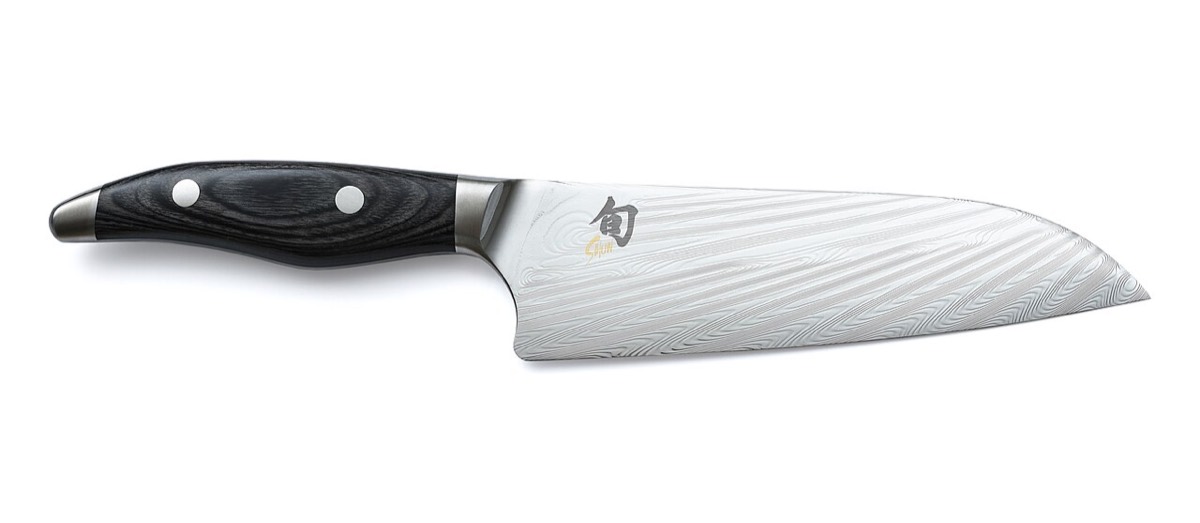
Today "Damascus knife" means a knife made of pattern-welded steel: two or more different steels stacked, forged together, folded or twisted, and then etched so the layers show as light and dark lines. On most Japanese kitchen knives the layers are only cladding on the outside of the blade, wrapped around a single hard core steel that forms the edge.
The name is borrowed. Historical Damascus steel, the kind famous for swords in the Middle East, was a different material made a different way (more on that below). Modern makers use the name for the look, because the etched layers resemble those old blades.
On a Japanese knife you will usually see it described in one of these ways:
- Damascus or "kasumi" Damascus cladding over a stainless core such as VG-10, SG2 (R2) or AUS-10.
- Suminagashi, a Japanese term for a similar layered, flowing pattern, sometimes over a carbon steel core like aogami or shirogami.
- Full Damascus, where the whole blade, edge included, is pattern-welded steel. This is less common in Japanese kitchen knives and more common in custom Western knives.
Historical Damascus vs modern Damascus
Historical Damascus blades were made from crucible steel, often called wootz, produced in small ingots in South Asia and forged into blades in the Middle East. Their pattern came from the steel's internal structure, not from layers. Modern Damascus is pattern-welded: separate steels joined by forge welding. They look alike but are different materials.
Crucible steel was made by melting iron with carbon-rich material in a sealed clay crucible, then cooling it slowly. The patterned surface came from bands of carbides that formed inside that single ingot as it was forged. The methods for making it fell out of use, and historians and metallurgists still debate exactly how the best blades were made.
Pattern welding is also old, used in Europe and elsewhere for centuries, and it is what nearly every "Damascus" kitchen knife sold today actually is. When a listing calls a knife "real Damascus steel", it almost always means pattern-welded steel, not crucible steel. That isn't dishonest by modern convention, but it helps to know what you're paying for.
How is Damascus steel made?
A smith stacks alternating sheets of two steels that etch differently, heats the stack and hammers or presses it until the layers weld into one billet. The billet is drawn out, cut, restacked and welded again to multiply the layers, then shaped, sometimes twisted or ground to create a pattern, and finally etched in acid to reveal it.
For a typical clad Japanese kitchen knife, the steps run roughly like this:
- Make the cladding. Thin layers of two stainless (or a stainless and a nickel-bearing) steels are forge-welded into a sheet. Many makers buy this layered sheet ready-made from a steel mill rather than forging it themselves.
- Sandwich the core. A sheet of hard core steel goes between two layers of the patterned cladding, and the three are welded together.
- Forge and grind. The blank is shaped into a blade. Grinding through the layers at an angle is what creates the wavy pattern you see; a flat, untouched surface would just show straight lines.
- Heat treat. The blade is hardened and tempered. This step decides how well the core steel performs.
- Etch. The finished blade is dipped in a mild acid (ferric chloride is common). One steel darkens more than the other, so the layers show up.
Layer counts in listings ("67 layers" and so on) count the cladding layers. More layers make a finer pattern. They don't make the knife cut better.
Why the core steel is what cuts
On a clad Damascus knife, only the core steel reaches the edge. The cladding stops a few millimeters above it. So sharpness, edge retention, ease of sharpening and chip resistance all come from the core steel and its heat treatment. The Damascus layers affect looks, a little stiffness and corrosion resistance on the face of the blade, and price.
You can usually see this on the blade itself: a wavy pattern on the upper part, then a plain band of brighter or darker steel along the bevel. That plain band is the core. It is a good sign, not a flaw.
When you compare Damascus knives, ignore the pattern at first and read the spec:
- Core steel. VG-10 is a common, solid stainless choice. SG2 / R2 powder steel holds an edge longer but costs more. Aogami and shirogami carbon steels take a very keen edge but can rust. Our guide to carbon vs stainless explains the trade-offs.
- Hardness (HRC). Makers usually list it. Japanese core steels are often hardened higher than German knives, which helps edge retention but makes the edge less forgiving of twisting and bones.
- Grind and thickness. A thin blade behind the edge cuts more easily than a thick one, whatever the steel.
Is Damascus steel good for knives?
Damascus cladding is neither good nor bad for cutting; it's neutral. A Damascus knife with a well heat-treated VG-10 or SG2 core is a good knife. A Damascus knife with a soft, poorly treated core is a poor one. The pattern adds cost and looks, and on stainless cladding it helps protect the face of the blade.
A few claims come up often and deserve a straight answer:
- "The layers make it sharper." No. Sharpness depends on the core steel, the edge angle and the sharpening.
- "The layers make it stronger." Laminated construction does let a maker pair a very hard edge steel with softer, tougher outer steel, so the blade is less brittle than a solid blade of the hard steel. That benefit comes from cladding in general, including plain, unpatterned cladding, not from the pattern.
- "The texture stops food sticking." An etched surface is slightly textured, and some people feel it helps. Blade geometry has a much bigger effect on sticking than surface finish.
Real vs fake Damascus: how to tell
A fake Damascus knife is a plain, single-steel blade with a pattern printed, laser-etched or stamped onto the surface. The quickest checks: real layered steel shows its pattern on the spine and in the edge bevel, the pattern varies naturally, and a plain core line runs along the edge. A fake pattern sits only on the flat face.
What to look for:
- Look at the spine. On real pattern-welded steel the layers run through the metal, so you'll see fine lines on the top of the spine and on the end of the blade at the heel. A printed or laser-etched pattern stops at the edge of the flat face, and the spine looks like plain steel.
- Look at the edge bevel. Where the blade is ground at an angle for the edge, real layers bend and change shape. A fake pattern either vanishes at the bevel or carries on as if the bevel weren't there.
- Look for the core line. Clad knives show a plain strip of core steel along the edge. A knife that is patterned right down to the very edge is either full Damascus (uncommon in budget knives) or a fake.
- Look at the pattern itself. Real patterns have small irregularities, and the two sides of the blade never match exactly. A pattern that is perfectly uniform, repeats like wallpaper, or is identical on both sides was probably printed or etched by laser.
- Feel the surface. Acid-etched layers often have a faint texture you can feel with a fingernail. Laser marking is usually completely flat, though this test isn't conclusive on its own.
- Read the listing. A real Damascus knife names its core steel and usually its cladding. Vague descriptions like "high-carbon Damascus pattern" with no core steel named are a warning sign.
A fake pattern doesn't make a knife dangerous, but it does mean you're paying a premium for decoration that may wear off, on a knife whose steel is often unnamed.
How to care for a Damascus knife
Care is the same as for any good Japanese knife: hand wash, dry it straight away, cut on wood or soft plastic, and keep it out of the dishwasher. The extra point for Damascus is that the etched pattern is a thin surface effect, so abrasive scrubbing, polishes and grinding will fade it over time.
- Washing. Warm water, mild soap and a soft sponge. Avoid scouring pads and powders on the face of the blade.
- Rust. Stainless cladding over a carbon core can still rust at the exposed core line. Dry the edge carefully. Some claddings include carbon or iron layers that can discolor too.
- Sharpening. Sharpening on a whetstone only touches the edge bevel, so it won't affect most of the pattern. Over years, as the bevel moves up the blade or if you thin the knife, the pattern near the edge will be ground away and shiny. See how to sharpen Japanese knives.
- Re-etching. A faded pattern can be brought back by cleaning and degreasing the blade and dipping it in a dilute ferric chloride solution, then neutralizing and oiling it. Ferric chloride stains and corrodes, so wear gloves and eye protection, keep it off the handle, and follow the product's safety instructions. If you're unsure, a knife sharpening service can do it.
Is a Damascus knife worth it?
Pay for Damascus if you like the look and the knife is already good underneath: a named core steel, a stated hardness, a thin grind and a reputable maker. Don't pay extra for the pattern alone. For the same money, a plain-finish knife with a better core steel or grind will usually cut better.
A sensible way to decide:
- Choose the knife first. Pick the type (a gyuto, santoku or nakiri) and the core steel you want.
- Then compare finishes. If a maker sells the same core steel and grind in plain and Damascus versions, the price difference is what the pattern costs. Decide whether that's worth it to you.
- Be wary of cheap "Damascus". At the low end of the market, a striking pattern and no named steel is the most common sign of a printed or laser-etched fake.
We're choosing picks on core steel and grind first, finish second.
Damascus knife questions
Are Damascus knives Japanese?
Not necessarily. Pattern-welded steel is made and used worldwide. Many Japanese makers offer Damascus-clad versions of their knives, but the look itself doesn't tell you where a knife was made.
Does Damascus steel rust?
It depends on the steels used. Stainless cladding over a stainless core resists rust well. Carbon steel cores, and claddings that include carbon or iron layers, can rust and need to be dried promptly.
Is a Damascus knife harder to sharpen?
No. You sharpen the core steel at the edge, so it sharpens like any knife with that core steel. Hard powder steels such as SG2 take longer on the stone than VG-10 or carbon steel, Damascus or not.
Why do Damascus knives cost more?
Layered cladding takes more material and more steps to make, the etching adds a step, and the look commands a premium. The cutting performance comes from the core steel, which may be the same as in the maker's cheaper plain-finish line.