Petty Knife: What the Japanese Utility Knife Is For
The short answer. A petty knife is a small Japanese utility knife, usually 120–150 mm long, with a narrow blade and a pointed tip. It handles the small jobs a chef's knife is too big for: shallots, garlic, herbs, fruit and trimming meat, and it is the most useful second knife to pair with a gyuto or santoku.
Author Name and photo pending
Testing status: Not tested yet We haven't tested a knife for this page. The numbers are typical ranges and makers' specs, and each one is marked.

On this page 10 sections
What is a petty knife?
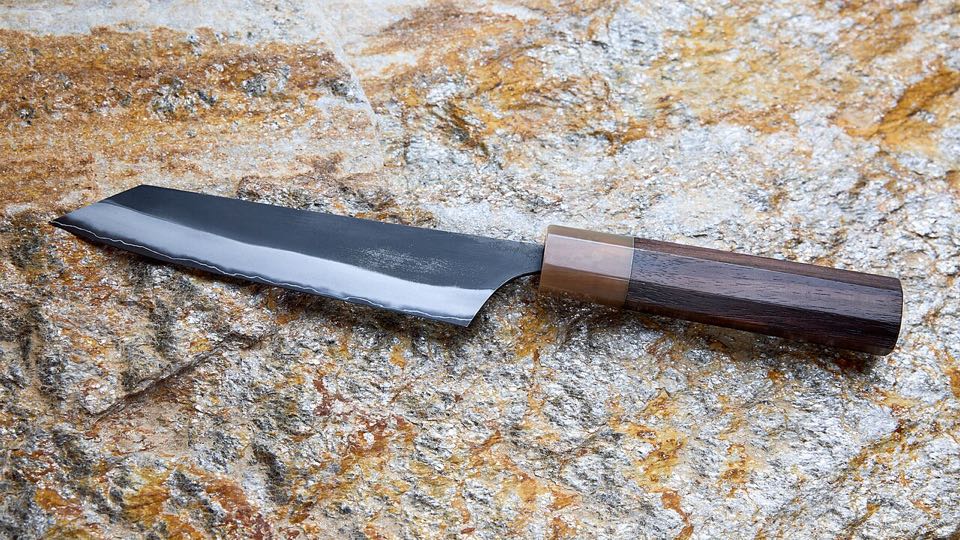
A petty knife is a short, narrow, double-bevel Japanese knife that looks like a scaled-down gyuto. It sits between a paring knife and a chef's knife in size. You can use it on the board or in the hand, which makes it the knife for the fiddly work your main knife is too tall or too long for.
The name comes from the French petit, "small", written in Japanese as ペティ. Like the gyuto, it is a Western shape that Japanese makers adopted and made thinner and harder.
Petty Drawn to scale
- Narrow blade. About 28 mm tall at the heel, so it turns easily around curves and in the hand.
- Slight belly and fine tip. Enough curve for small rocking cuts, with a sharp point for detail work.
- Short length. Quick to grab, easy to control, and fine on a small board.
What is a petty knife used for?
A petty knife is used for small, precise jobs: mincing shallots and garlic, slicing herbs, segmenting citrus, coring tomatoes and strawberries, trimming fat and silverskin from meat, and cutting sandwiches, cheese and fruit. It is also handy for in-hand work like peeling an apple or hulling berries.
- Shallots, garlic, ginger and small amounts of herbs
- Fruit: citrus segments, apples, mango, stone fruit, berries
- Trimming chicken, pork and steak, and removing silverskin
- Scoring onions, deveining shrimp and other tip work
- Quick jobs: a lemon, a sandwich, a block of cheese
A petty is too short and narrow for big vegetables like cabbage or squash, and too thin for bones. Use your main knife or a heavier knife for those.
Petty vs paring knife vs utility knife
A petty knife is longer than a paring knife and overlaps with what American stores call a utility knife. Paring knives are usually under 100 mm and work mostly in the hand. Petty knives run 120–150 mm and work both in the hand and on the board. A Western utility knife covers a similar length range but is often thicker and softer.
- Paring knife (about 75–100 mm). Best for peeling, coring and in-hand work. Too short for most board work.
- Petty (120–150 mm). Does most paring jobs and small board jobs too. The more versatile of the two.
- Western utility knife (similar length). Fills the same role, sometimes with a serrated edge. Usually heavier and sharpened at a wider angle.
The names overlap in practice. Some makers sell a 150 mm petty as a "utility knife", and some call a 120 mm petty a "paring knife", so go by the length and shape rather than the label. If you only want one small knife, a petty is the better choice. If you do a lot of peeling and in-hand trimming, a 120 mm petty covers most of what a paring knife does.
Petty vs gyuto
A petty is basically a small gyuto: same pointed shape, same double bevel, a little over half the height and about two-thirds the length. A gyuto does the bulk of the cutting; the petty does the small, precise jobs. They are made to work together rather than replace each other.
Gyuto and Petty Drawn to scale
For more on the main knife, see the gyuto page. If you prefer a shorter, flatter main knife, a santoku pairs just as well with a petty.
What size petty knife should you buy?
For most cooks, a 135 mm or 150 mm petty is the right size. 135 mm balances in-hand control with enough length for small board jobs. 150 mm leans toward board work and slicing larger fruit. 120 mm is the closest a petty gets to a paring knife, good for in-hand peeling and small hands.
- 120 mm. Most paring-like. Best if you work in the hand a lot.
- 135 mm. The common middle size and a good default.
- 150 mm. Most board-friendly. Good for trimming meat and slicing fruit and cheese.
Is a petty a good second knife?
Yes. For most home cooks, a petty is the most useful second Japanese knife. Your main knife handles the big prep; the petty takes over for shallots, garlic, fruit, trimming meat and anything you'd rather do in the hand. Together, a gyuto or santoku and a petty cover nearly all everyday cooking.
A bread knife is the usual third, for crusty loaves and tomatoes. Specialist knives come later, if ever.
Steel and handle
Most petty knives are stainless or stainless-clad, and that suits a knife you'll use on acidic fruit and pick up throughout the day. Carbon steel petties exist, but citrus and tomato will discolor them quickly unless you wipe them right away. Handles are yo (Western) or wa (Japanese), as on bigger knives; choose the one that feels secure in a pinch grip.
How to sharpen a petty knife
A petty is double bevel and usually sharpened at about 12–15° per side, the same as a gyuto. Sharpen it on a whetstone: a 1000 grit stone to set the edge, then a 3000–6000 grit stone to refine it. Because the blade is short and narrow, the main challenge is keeping a steady angle, especially through the curve near the tip.
A short, 28 mm-tall blade needs a small lift: at 15°, the spine sits only about 7 mm above the stone. That's easy to overshoot, so check it with the angle tool before you start. Use light pressure, work in short sections, and lift the handle slightly as you reach the tip. The whetstone guide has the full steps.
Which petty knife to buy
We're testing petty knives at three budgets: under $100, $100–200 and above. Each one gets weighed and measured, then used for a month of everyday cooking before it goes on this list.
Tojiro DP Petty 150mm
On our list, not tested yet. No recommendation until we have used it.
- Price
- under $80 (typical range)
We measuredMaker's specTypical range
Petty knife questions
What is a petty knife?
A small Japanese utility knife, usually 120–150 mm, with a narrow blade and a pointed tip. It is used for small, precise jobs on the board or in the hand.
Can a petty knife replace a paring knife?
For most people, yes. A 120 or 135 mm petty does nearly all paring jobs, and it also handles small board work a paring knife can't.
Can a petty knife be your only knife?
Not comfortably. It is too short and narrow for big vegetables and large cuts. Pair it with a gyuto or santoku.
Is a petty knife good for left-handed cooks?
Yes. Petty knives are double bevel and work in either hand. Check the handle shape: a D-shaped wa handle is made for one hand.
Is a petty knife good for meat?
Yes, for trimming and small boneless cuts. Its narrow tip is good at removing fat and silverskin. Keep it off bones.