Sushi Knife Guide: The Yanagiba Sashimi Knife
The short answer. A sushi knife, properly called a yanagiba, is a long, narrow Japanese knife with a single-bevel edge, usually 240–300 mm long. It slices raw fish for sashimi and sushi in one long pulling stroke, which leaves a smooth, glossy cut surface instead of the torn, ragged face a shorter knife leaves when sawing.
Author Name and photo pending
Testing status: Not tested yet We haven't tested a knife for this page. The numbers are typical ranges and makers' specs, and each one is marked.

On this page 12 sections
What is a yanagiba knife?
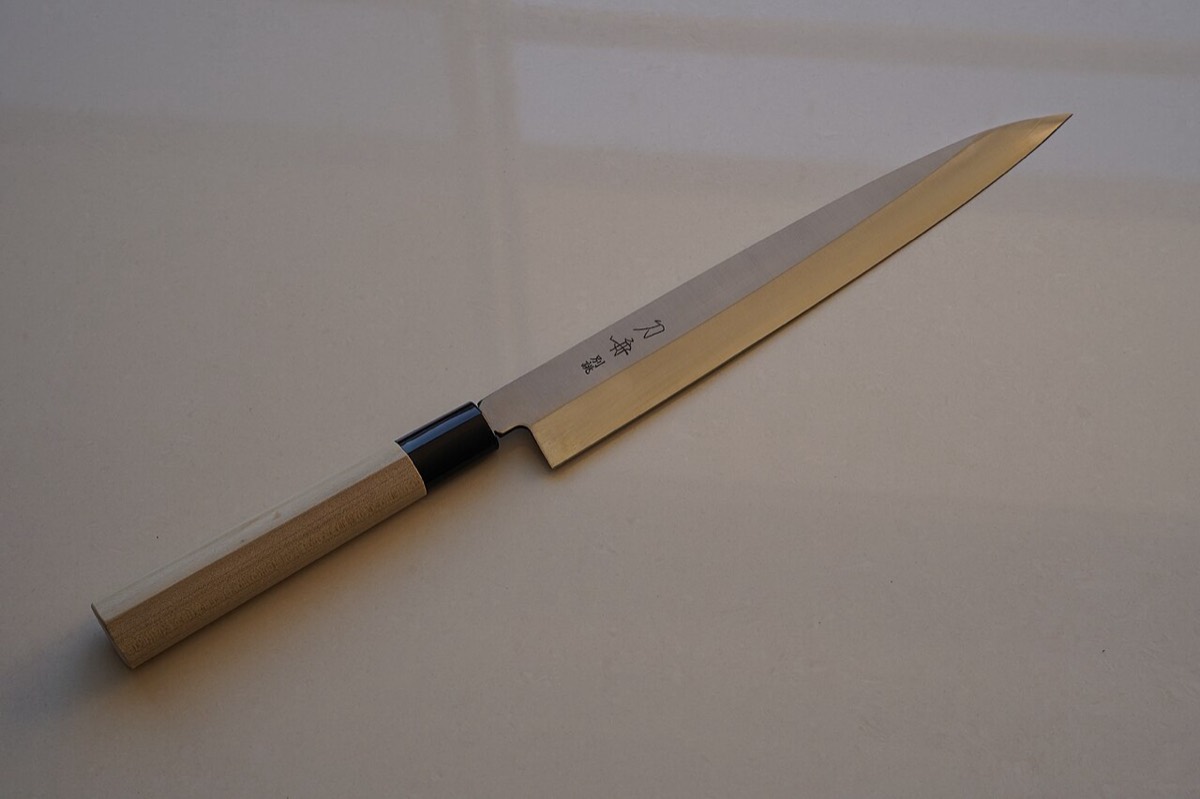
A yanagiba is the traditional Japanese slicing knife for raw fish. It has a long, slender blade, a pointed tip and a single bevel: the edge is ground on one side only, with a flat, slightly hollow back. That geometry lets it cut very thin, very clean slices. It is a specialist knife, not an everyday one.
Yanagiba (柳刃) means "willow blade", after its long, narrow shape. It is the most common style of sashimi knife in Japan and the knife most English speakers mean by "sushi knife" or "Japanese sushi knife".
Yanagiba Drawn to scale
- Long blade. Long enough to cut through a block of fish in a single stroke without sawing.
- Narrow height. About 34 mm tall, which reduces drag as the blade passes through the flesh.
- Single bevel. Ground on one side for a very acute edge, and handed: right-handed or left-handed.
Sushi knife or sashimi knife: what's the difference?
There isn't one. "Sushi knife", "sashimi knife" and "yanagiba sushi knife" all usually refer to the same knife: the yanagiba. In Japan it is more often thought of as a sashimi knife, since its main job is slicing raw fish. In English, "sushi knife" has become the common name.
A few related knives are sometimes sold under the same names. The takohiki is the Tokyo-style sashimi knife, with a square tip instead of a point. The fuguhiki is a thinner, more flexible version for paper-thin slices of blowfish. For cutting sushi rolls at home, any long, very sharp, thin knife works; many cooks wipe the blade with a damp cloth between cuts so the rice doesn't stick.
How a single-bevel edge works
A single-bevel knife is ground on one side only. The front face has a wide bevel that runs up to a line called the shinogi; the back is flat with a shallow hollow (the ura). This creates a thinner, sharper edge than a double bevel of the same steel, and it pushes the slice away from the blade cleanly.
Single bevels come with trade-offs. The uneven grind makes the knife tend to drift off line on straight cuts, which takes getting used to. It is made for one hand only. And it needs a specific sharpening routine. For the wider picture of single and double bevels across Japanese knives, see the bevel explainer.
How to slice sashimi with a yanagiba: the pull-cut
The yanagiba is used with a pull-cut. Place the heel of the blade on the far edge of the fish, then draw the whole knife toward you in one long, smooth stroke, letting the length of the edge do the work with almost no downward pressure. Don't saw back and forth: every reversal tears the flesh.
- Start with a well-chilled, trimmed block of fish (a saku), skinned and boned.
- Set the heel of the edge on the fish, with the tip angled slightly up.
- Pull toward you in a single stroke, finishing near the tip.
- Use the flat of the blade to move the slice aside, then repeat.
Thickness and angle depend on the fish and the style of sashimi. The point of a long knife is that the stroke is long enough to finish the cut in one go.
What length yanagiba should you buy?
For home use, a 240 mm or 270 mm yanagiba is the right size. 240 mm is easier to handle on a home board and is enough for most blocks of fish you'll buy. 270 mm is a common professional length and gives a longer, smoother stroke. 300 mm and up suits restaurant counters and large fish.
- 240 mm. The easiest to handle and store at home.
- 270 mm. The most common size overall; a good choice if you slice fish often.
- 300 mm and up. Professional sizes. They need a long board and practice.
Left-handed sushi knives
Because a yanagiba is single bevel, it is made for one hand. A standard yanagiba is right-handed; a left-handed sushi knife is a mirror image, with the bevel on the other side. Using a right-handed yanagiba in your left hand steers the cut the wrong way and makes clean slices very hard.
Left-handed versions are made by many Japanese makers but are less common in stock, and they are often more expensive or made to order. Check the listing carefully: the word "left-handed" should appear explicitly. A sujihiki is a double-bevel alternative that works in either hand.
Yanagiba vs sujihiki
A yanagiba is a single-bevel raw-fish knife. A sujihiki is a double-bevel slicer of similar length that works in either hand and is easier to sharpen. A yanagiba gives a cleaner cut on raw fish. A sujihiki is more versatile: it slices roasts, ham and cooked meat as well as fish, and it is the easier choice for most home cooks.
Yanagiba and Sujihiki Drawn to scale
If you mostly want to slice cooked meat, or you are left-handed and can't find a left-handed yanagiba, a sujihiki is the better buy.
Is a yanagiba right for a beginner?
Usually not as a first knife. A yanagiba does one job, slicing raw fish and other boneless protein, and it needs single-bevel sharpening and careful handling. Buy one if you make sashimi or sushi regularly and already own an everyday knife. Otherwise, start with a gyuto or santoku.
Signs a yanagiba is a good fit: you buy whole fillets or sashimi-grade blocks, you're happy to learn whetstone sharpening, and you'll use it often enough to justify a knife that does nothing else.
How to care for a yanagiba
A yanagiba's edge is thin and hard, and many are carbon steel, so care matters. Hand wash and dry it right after use, never put it in a dishwasher, and store it in a saya (wooden sheath) or on a magnetic strip. Never use it on bones, skin with scales, or frozen fish: the edge will chip.
- Wipe it dry between tasks if it is carbon steel; fish and acidic food encourage rust spots.
- Use a wood or soft plastic board, never glass or stone.
- Don't scrape food off the board with the edge; turn the knife over and use the spine.
How to sharpen a single-bevel yanagiba
A yanagiba is sharpened mostly on its beveled side. Lay the wide bevel flat on the stone so the existing grind sets the angle, and work along the edge until you raise a burr on the back. Then lay the back flat and take just a few light strokes to remove the burr. Never put a bevel on the back.
Start on a 1000 grit stone and finish on a finer stone. Keep the back flat: grinding an angle into it ruins the hollow and makes the knife harder to sharpen in future. Because the edge geometry comes from the factory bevel, the angle tool is less useful here than on a double-bevel knife. Our guide to sharpening Japanese knives covers single-bevel technique in detail, and the whetstone guide covers the basics.
Which yanagiba to buy
We're testing yanagibas at three budgets: under $100, $100–200 and above, including at least one available in a left-handed version. Each gets measured, sharpened and used on fish before it goes on this list.
Sushi knife questions
Is a yanagiba the same as a sushi knife?
Yes. "Sushi knife" is the common English name for the yanagiba, the Japanese single-bevel knife for slicing raw fish.
Do I need a sushi knife to make sushi at home?
No. A sharp gyuto or sujihiki slices fish well enough for home sushi. A yanagiba gives cleaner, glossier cuts if you make sashimi often.
Can a left-handed person use a regular sushi knife?
Not well. A standard yanagiba is right-handed. Buy a left-handed version, or a double-bevel sujihiki.
Can you use a yanagiba for meat?
Yes, for slicing boneless meat. It is not for bones, cartilage or frozen food.
What size sushi knife is best for home?
240 mm or 270 mm. Longer knives suit professional counters.
Is a yanagiba hard to sharpen?
It takes a different technique from a double-bevel knife, but the wide bevel makes the angle easy to find. Keep the back flat and take only light strokes on it.