Leather strop: how to strop a Japanese knife
The short answer. A leather strop is the last step after a whetstone: a dozen or so light, spine-first strokes per side clean up the leftover burr and polish the edge, and a quick session between sharpenings brings back an edge that has only just started to fade. It can't sharpen a dull or chipped knife, and bare leather works far more slowly than leather loaded with a fine compound such as green chromium oxide.

On this page 8 sections
What a leather strop does
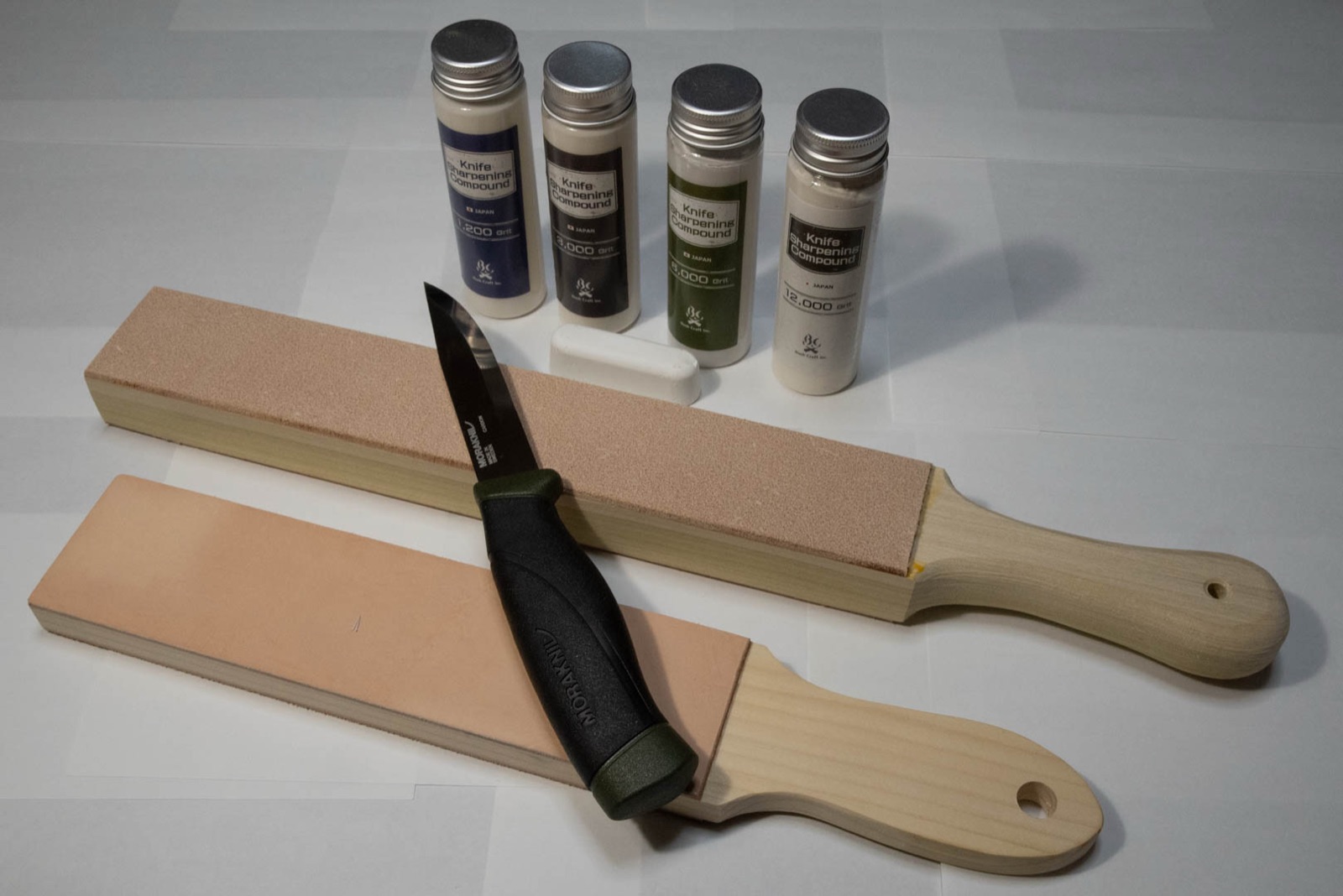
A strop is a strip of leather glued to a wooden paddle or block. Many have rough suede on one side and smooth leather on the other. Stropping is the finishing step of sharpening, not a separate way to sharpen.
A strop does two jobs:
- It cleans up the burr. Sharpening on a stone leaves a tiny, ragged lip of steel along the edge. Stropping wears that lip down and straightens what is left of it.
- It polishes the edge. It smooths out the scratches the stone left right at the apex, without removing much steel. A polished edge feels keener and slides through tomato skin and other soft food more cleanly.
How much of this bare leather does by itself is debatable. When materials scientist John Verhoeven examined stropped edges under an electron microscope, clean leather barely changed the burr or the stone scratches, while the same leather loaded with 0.5 micron chromium oxide compound smoothed them out dramatically (John D. Verhoeven, Experiments on Knife Sharpening, Iowa State University, 2004; PDF copy hosted by the University of Kiel). Later electron-microscope images on the Science of Sharp blog suggest bare leather does wear the very edge, just slowly. If you want the strop to do real work in a few strokes, load it with compound.
Either way, a strop removes so little steel that it can't change the shape of an edge.
When a strop helps, and when it doesn't
A strop helps:
- Right after sharpening on a whetstone, to finish the edge.
- Between sharpenings, when a good edge has lost a little bite. A short session about once a week keeps a sharp knife sharp for longer.
A strop won't help:
- When the edge is dull all over. Look straight down at the edge under a light: if you see a thin line of reflected light, the edge is rounded and needs steel removed on a stone.
- When the edge has chips or a nick. Only a stone grinds those out.
- When the knife was never sharpened well in the first place. Stropping refines a good edge; it can't make one.
The whetstone makes the edge, and the strop maintains it. Stropping pays off most after a fine stone, around 5000–6000 grit (see our grit guide).
How to strop a Japanese knife
The rule that matters most: always move the knife spine first, with the edge trailing behind. If you push edge-first, as you would on a stone, the edge digs in and cuts the leather.
-
Clean the knife and steady the strop
Wash and dry the blade first so you don't drag stone grit into the leather. Lay a bench strop on a counter, or hold a paddle strop by its handle so it is steady and level. Work on the suede side first if your strop has two sides.
-
Lay the blade at your sharpening angle
Set the edge on the leather at the angle you sharpened at, or a hair lower. For most double-bevel Japanese knives that is about 12–15° per side; the angle tool shows how high that puts the spine. Leather gives a little under the edge and wraps around it, so you don't need to be exact, but don't go higher than your sharpening angle: that is how a strop rounds an edge.
-
Pull spine first, with almost no pressure
Pull the knife along the strop in the direction the spine is facing, so the edge trails behind. Use very light pressure, about half a pound (roughly 200 g); pressing the blade onto a kitchen scale once shows how little that is. Heavy pressure sinks the edge into the leather, which then curls up around it and rounds it off, leaving the knife duller than before.
-
Follow the curve to the tip
Sweep the blade as you pull, so every part of the edge from heel to tip touches the leather. On a curved gyuto, lift the handle slightly as you reach the tip, using your wrist rather than your whole arm. At the end of each stroke, lift the knife straight off; flicking it up at the end can round the very tip.
-
Alternate sides, then finish on smooth leather
Turn the knife over the spine and pull the other side the same way. About a dozen strokes per side is plenty, alternating sides every stroke or two. If your strop has a smooth side, finish with a few lighter strokes per side on it.
Check the result by slicing a sheet of printer paper held by one corner: a sharp edge cuts it cleanly with little pressure. If it still snags in the same spot after a second round of stropping, the problem is in the edge itself and needs the stone.
Single-bevel knives such as a yanagiba or deba are stropped mostly on the bevel side. Lay the wide bevel flat on the leather, as you would on the stone, and pull spine first. Then lay the back completely flat and give it one or two very light strokes. Never tilt the back up to put an angle on it. See how to sharpen a single-bevel knife for why the back must stay flat.
Do you need stropping compound?
Not strictly, but it does most of the work, as the microscope evidence above shows. In Verhoeven's tests the compound-loaded strop also reduced the larger burrs left by a coarse 600 grit wheel, which bare leather left in place.
The usual choice is green chromium oxide, sold as a waxy bar with a particle size of about 0.5 microns, the same grade Verhoeven used. Diamond sprays and pastes work too and come in a range of sizes; if you use more than one, give each its own strop or strop side so they don't mix. A common setup is compound on the suede side and the smooth side left bare.
- Apply a thin coat. Rub the bar over the leather like a crayon, then spread it with your palm or a finger. A thick, gummy layer doesn't polish better and can glaze the surface.
- Top it up occasionally. Knifewear suggests recoating the suede side of its leather strop with chromium oxide every few months. In practice, reload when strokes stop changing the edge.
Common stropping mistakes
- Leading with the edge. It cuts the strop. Always pull spine first.
- Pressing too hard. The leather wraps around the edge and rounds it. Keep to about half a pound of pressure.
- Holding the spine too high. A steeper angle than you sharpened at polishes a rounded micro-bevel onto the edge. Stay at or just below your sharpening angle.
- Stropping a dull knife. If the edge still snags on paper after a round of stropping, more stropping won't help. Go back to the stone.
- Too many strokes. About a dozen per side is enough. Endless stropping on soft leather slowly rounds a good edge.
- Stropping serrated knives. The teeth catch and gouge the leather. Skip it.
Strop, ceramic rod or newspaper?
The rod is quicker mid-cooking and takes up less room; the strop is gentler on hard, thin edges and easier to use on single-bevel knives. Avoid the grooved steel rod sold with many German knife sets: on hard Japanese steel (roughly 60 HRC and up) its ridges can chip the edge instead of straightening it. Our comparison of Japanese vs German knives explains why the two need different upkeep.
If you don't own a strop yet, a sheet of newspaper or plain cardboard laid on a flat counter works as a stand-in after sharpening, though like bare leather it works gently unless you rub a little compound into it. Use the same spine-first strokes and light pressure.
Choosing and caring for a strop
For kitchen knives, choose a strop with the leather glued to a firm wooden base. It flexes less than loose leather, which keeps the edge from rounding. Hanging strops are made for straight razors and are hard to use with a long, stiff kitchen blade. Size matters more than brand: a short paddle is fine for petty knives and other blades around 150 mm, while a longer strop makes it easier to sweep a 210–240 mm gyuto in one stroke.
Keep the strop dry and away from water, since the leather and the wood both suffer when wet. Wipe off dust and steel with a dry cloth. If the leather turns dark and glassy, it has glazed over with steel and old compound; scrape it gently with the spine of a knife, or very lightly sand it, to bring it back. A light coat of leather conditioner on the bare side once a year helps, more often in dry climates; don't condition a side loaded with compound.
Leather strop questions
Which way do you strop a knife?
Spine first, with the edge trailing. Pushing the edge into the leather cuts the strop.
How often should you strop a kitchen knife?
After every sharpening, and then briefly about once a week or whenever the edge feels a little less keen. When stropping no longer brings the edge back, it is time for the stone.
Can a strop replace a whetstone?
No. A strop polishes and maintains an edge but removes very little steel, so it can't fix a dull or chipped knife.
Do you need compound on a strop?
You can strop on bare leather, but compound such as 0.5 micron green chromium oxide is what does most of the burr removal and polishing.