Deba knife: what it's for, sizes and who needs one
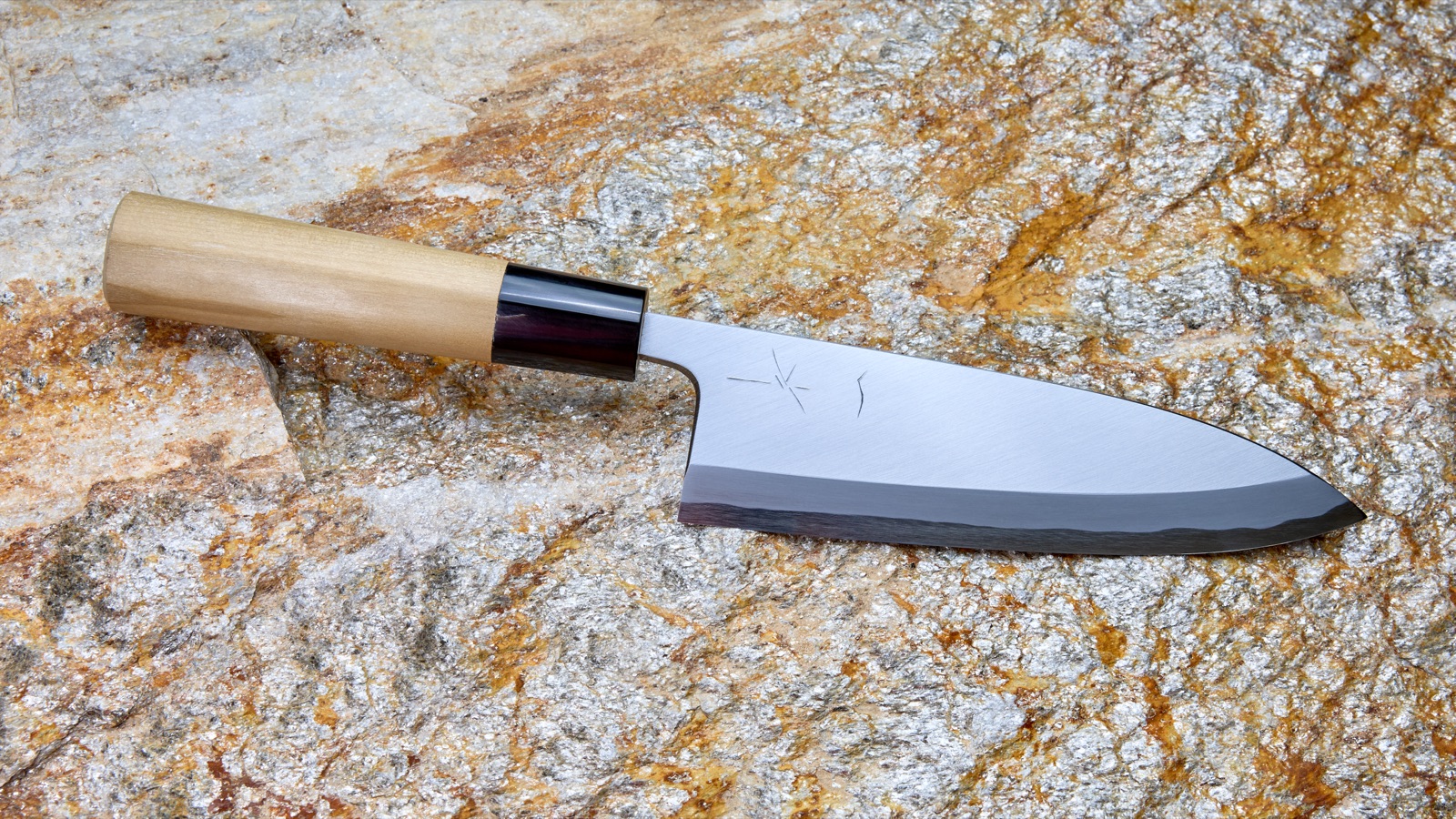
The short answer. A deba is a thick, heavy, single-bevel Japanese knife made for breaking down whole fish: taking off the head, cutting through the collar and lifting fillets off the backbone. It is a specialist tool, so you only need one if you regularly buy whole fish and clean them yourself.

On this page 8 sections
What is a deba knife?
It is the heaviest of the three. Most debas are about 120–200 mm long with a spine about 5–7 mm thick, and the largest reach roughly 300 mm and 10 mm (figures from the Wikipedia entry on the deba bōchō).
Deba Drawn to scale
Deba, 165 mm blade, about 50 mm tall at the heel (typical size, not a measured knife).
Three features define a deba:
- Weight and thickness. The heavy heel can cut through a fish's head and collar bones without flexing.
- A single bevel. One side is ground to a wide bevel; the other is nearly flat, with a shallow hollow (urasuki) on better knives. The flat back lets the blade run close along the backbone so little flesh is left behind.
- A pointed tip. The thinner front of the blade opens the belly and follows the bones.
Sakai was making deba knives, and was known for them across Japan, by the early Edo period, according to Osaka Prefecture's traditional crafts listing. Our history of Sakai knife making covers the background.
What a deba does to a whole fish
The classic job is sanmai oroshi, "three-piece filleting": a whole fish becomes two fillets and a bare skeleton. The deba makes every cut:
- Scale and gut. Scrape off the scales with a fish scaler, then open the belly with the tip so the innards come out cleanly.
- Take off the head. The heel cuts behind the gills and through the collar, where the weight of the blade does most of the work.
- Lift the fillets. Cut along the belly side first, then the back, running the blade along the spine with the flat side toward the bones until the first fillet comes free. Turn the fish and repeat.
- Trim the ribs. Shave the rib bones off each fillet, staying close to the bone. If you're serving the fish raw, pull the pin bones with fish tweezers.
The Tsuji culinary school's photo sequence for three-piece filleting a mackerel shows each cut. Once the fish is filleted, the deba hands over to a slicer: a yanagiba or another long, thin knife cuts sashimi or portions in single strokes.
The heel also handles small poultry joints and cartilage: find the gap between bones rather than chopping through them. It will also cut through crab shells; crack heavy lobster claws with a shellfish cracker, not the edge.
What a deba is not for
The deba is heavy, but it is not a cleaver. Its steel is hard, and a hard edge chips when it is twisted or driven into thick bone. Don't use it on:
- Large bones of beef, pork or lamb
- Frozen food
- Thick chicken bones chopped straight through (cut at the joints instead)
A deba is also a poor everyday knife. The thick, wedge-shaped blade pushes dense vegetables apart instead of slicing them, and the single bevel steers the cut. For vegetables and boneless meat, use a double-bevel knife such as a gyuto or santoku.
Deba types and sizes
"Deba" covers a family of knives. Names and lengths vary by maker; the ranges below come from the zknives knife-type reference and show the full span you'll see for sale, with the most common sizes in brackets.
| Type | Length range (most common) | What it's for |
|---|---|---|
| Ko-deba (small deba) | 75–135 mm (105–120 mm) | Small fish such as horse mackerel (aji) |
| Hon-deba (standard deba) | 150–330 mm (180–240 mm) | The heaviest, thickest form; the all-round fish butchery knife |
| Ai-deba | 135–270 mm (195–240 mm) | Lighter, with a thinner spine; sits between a hon-deba and a mioroshi |
| Mioroshi deba | 165–330 mm (210–240 mm) | Long and slender, built mainly for filleting |
| Kanisaki deba | 180–210 mm | Specialist knife for crab and shellfish; on a right-handed kanisaki the bevel is on the left, the reverse of a standard deba |
| Yo-deba (Western deba) | 165–300 mm (210–240 mm) | Double bevel with a Western handle; works in either hand |
Which size? Match the knife to the fish. Ichimonji, a knife shop in Tokyo's Tsukiji market, says in its deba buying notes that home cooks typically choose 150–165 mm and suggests 180–195 mm for larger fish such as sea bream and yellowtail. A 150–165 mm deba covers the whole fish most US fish counters sell, such as trout, branzino, mackerel and small snapper. If you mostly clean small fish, a ko-deba of about 105–120 mm is easier to control and cheaper, but it limits you to small fish. At the other end, the retailer Knives and Tools suggests a blade of about 240 mm for a whole salmon. A bigger deba is heavier: it takes off heads more easily but tires your hand faster on small fish.
Deba and Gyuto Drawn to scale
Left-handed deba knives
A standard deba is ground for right-handed use, with the bevel on the right side of the blade as you hold it. In a left hand, a right-handed deba steers the cut the wrong way and leaves flesh on the bone, and you can't fix that by sharpening.
Left-handed debas exist, with the bevel on the left, but they are usually a special order. Korin, a New York retailer, says on its left-handed knife page that left-handed traditional Japanese knives are made to order, can take up to two months and cost 50% more than the right-handed version. Some shops keep a few left-handed debas in stock, so it pays to ask. A double-bevel yo-deba avoids the problem, since it works in either hand. Our notes on left-handed single-bevel knives cover how sharpening differs.
Steel, care and sharpening
Traditional debas are made from carbon steel, often a hard core forge-welded to softer iron. Stainless single-bevel debas exist too (silver steel, or ginsan, is a common choice), and most yo-debas are stainless. Carbon steel takes a keen edge easily but rusts if left wet, and fish work is wet, salty work. Wipe the blade as you go, wash and dry it straight after use, and store it dry in a saya (wooden sheath) or on a rack. Our comparison of carbon vs stainless steel sets out the trade-off.
Sharpen a deba like any single-bevel knife: lay the wide bevel flat on the stone and work it until a burr forms on the back, then remove the burr with a few light strokes with the back held flat. Never grind a bevel onto the back. Our guide to sharpening single-bevel knives walks through the steps. Between sharpenings, a few spine-first passes on a leather strop help keep the edge clean.
Do you need a deba?
Get a deba if you buy whole fish often, from a fish market or your own fishing, and want to break them down cleanly. It is built for exactly that job, and it keeps fish bones away from your chef's knife.
Skip it if you buy fish already filleted, which covers most home cooks. A gyuto or santoku handles fillets, and a flexible Western fillet knife is easier to learn if you only clean a whole fish now and then (ask the fishmonger to take the head off). If you are left-handed and can't get a left-handed blade, choose a yo-deba instead of a right-handed single-bevel deba.
Deba knife questions
Is a deba the same as a fillet knife?
No. A Western fillet knife is thin and flexible; a deba is thick, stiff and single bevel, so it can also take off heads and cut through collars. The slimmer mioroshi deba is the member of the family built mainly for filleting.
Can you use a deba knife for chicken?
Yes, with care. Use the heel to cut through joints and cartilage, not through thick bones. For taking whole birds apart, a honesuki is the purpose-built Japanese knife, and a cleaver is the tool for chopping through bone.
What size deba knife should you get?
For most home cooks, about 150–165 mm. Choose a ko-deba of about 105–120 mm if you mainly clean small fish, and 180–195 mm for larger fish such as sea bream or yellowtail.
Is a deba knife single or double bevel?
A traditional deba is single bevel. The Western-style yo-deba is double bevel.