Kiritsuke knife: what it is, what it's for and who should skip it
The short answer. A kiritsuke is a long Japanese knife with a mostly flat edge and an angled "k-tip", used for push-cutting vegetables and slicing boneless fish and meat. The traditional version is single bevel and takes practice to use, while most kiritsukes sold to US home cooks are double-bevel "kiritsuke gyutos" that sharpen and handle like a chef's knife but have a flatter edge suited to push-cutting rather than rocking.

On this page 8 sections
What is a kiritsuke knife?
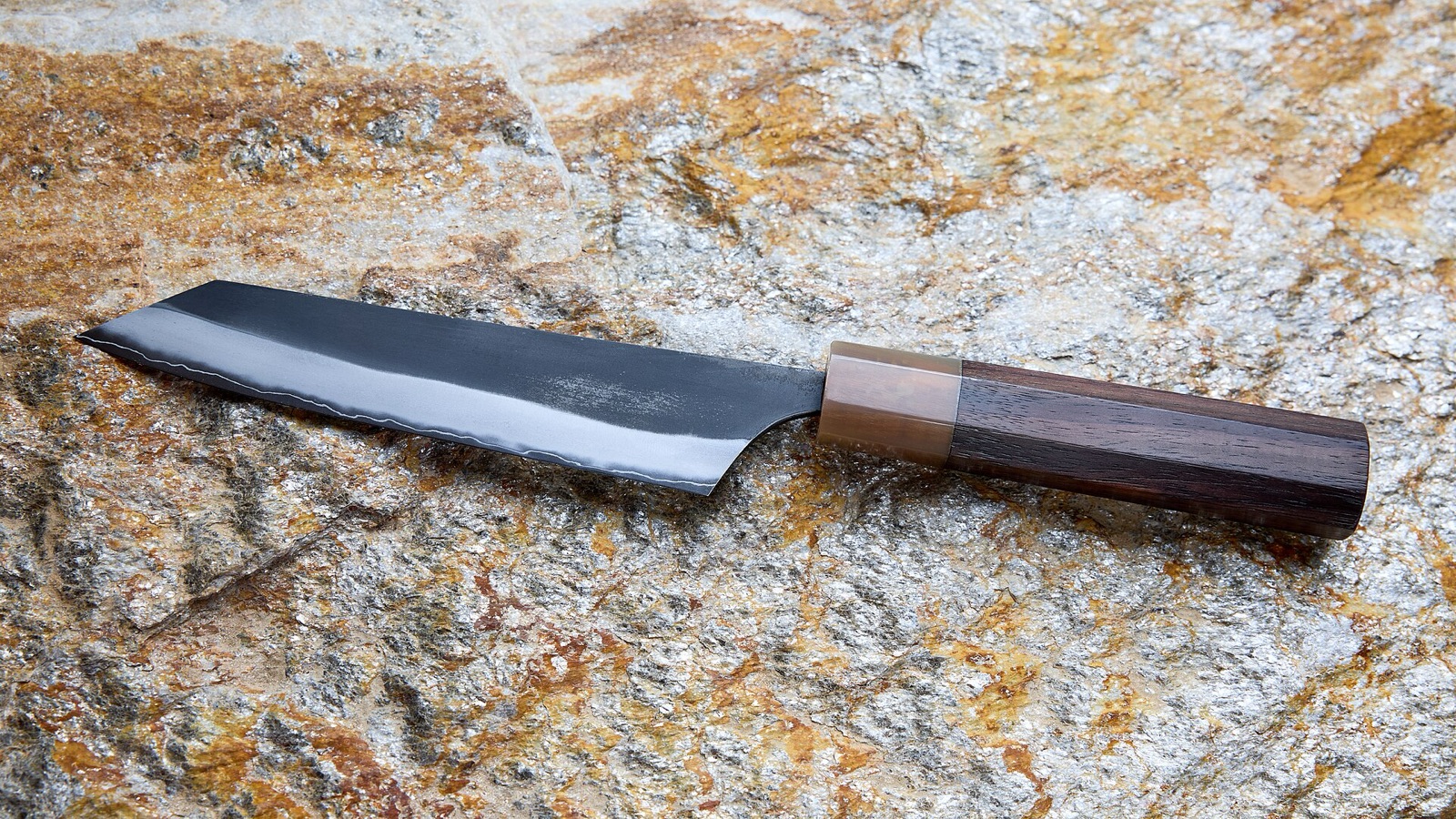
A kiritsuke (切付) is defined by its outline: a long, fairly flat edge and an angled tip where the spine drops in a straight line to meet the edge. That tip is often called a k-tip or reverse tanto tip. Most kiritsukes are about 200–270 mm long; traditional single-bevel ones are usually at the longer end, around 240–300 mm.
Kiritsuke Drawn to scale
Kiritsuke, 240 mm blade, about 48 mm tall at the heel (typical size, not a measured knife).
The name covers knives that share that outline but are ground very differently:
- The traditional kiritsuke, a single-bevel knife from Japanese professional kitchens. It is ground on one side only, like a yanagiba or usuba.
- The kiritsuke gyuto (also sold as a "k-tip gyuto" or just "kiritsuke"), a double-bevel chef's knife with a kiritsuke tip. It is ground on both sides, like any Western or Japanese chef's knife.
- The kiritsuke yanagiba (kiritsuke yanagi), a single-bevel sashimi slicer with the angled tip in place of a yanagiba's pointed one. It is a fish knife first, and you will often find it in the same "kiritsuke" category online.
Most kiritsukes sold to home cooks in the US are the kiritsuke gyuto. Shun's 8-inch Classic Kiritsuke, for example, has a 16° edge on each side, so it is double bevel. As one specialist retailer's guide to k-tip gyutos points out, the tip shape doesn't tell you how the edge is ground, so check the bevel in the product details.
What is a kiritsuke used for?
A double-bevel kiritsuke covers most everyday prep:
- Slicing and dicing onions, carrots, cucumbers and peppers with push-cuts
- Fine slicing of scallions, cabbage and herbs
- Scoring onions and other detail work with the tip
- Slicing boneless meat, poultry and fish in long strokes
A traditional single-bevel kiritsuke is used more narrowly: thin, clean slices of raw fish for sashimi, and precise vegetable cuts where the flat back leaves a clean surface. That is specialist work, and a kiritsuke yanagiba is narrower still, built mainly for slicing fish.
If you are coming from a curved chef's knife, push each cut forward and down until the whole edge reaches the board. A flat edge that is rocked or lifted early leaves slices joined at the bottom.
No version is meant for bones, frozen food or prying through hard squash. The long, thin blade and fine tip chip under that kind of force.
The traditional single-bevel kiritsuke
The traditional kiritsuke is usually described as a hybrid of two single-bevel knives. It is long enough to slice raw fish in one pull like a yanagiba, and flat enough to push-cut vegetables like an usuba. Korin, a long-established Japanese knife retailer in New York, calls it one of the few multi-purpose traditional Japanese knives, usable as either.
It also has a reputation. Korin and many other sellers say it was traditionally used only by the executive chef in a Japanese kitchen, but none of the sellers we read cites a historical source, so treat it as lore. The practical point behind it is sound: a long single-bevel knife is hard to control, so it makes sense in the hands of the most experienced cook.
A single bevel changes how the knife behaves:
- It steers. All of the wedge is on one side, so thick or hard food pushes the blade sideways instead of splitting evenly. You learn to correct for it.
- It is handed. A standard single-bevel knife is right-handed, and a left-handed cook needs a mirror-image blade. Korin, for example, notes that left-handed blades must be special ordered from Japan, so expect a higher price and a wait.
- It sharpens differently. You sharpen the wide bevel flat on the stone and only touch the flat back lightly. See how to sharpen a single-bevel knife.
The double-bevel kiritsuke gyuto
The kiritsuke gyuto puts the kiritsuke outline on a double-bevel chef's knife. It cuts straight, works in either hand and sharpens like any double-bevel knife. If a listing gives an uneven grind such as 70/30, the edge is set up for right-handers; a left-handed cook should look for 50/50 or have it rebalanced when sharpening. Keep roughly the factory angle when you sharpen: Shun quotes 16° per side for its kiritsukes, so check the listing for yours. The sharpening angle guide shows how to hold an angle on a whetstone.
Compared with a standard gyuto, it has two differences you will notice:
- A flatter edge. A gyuto has a curved belly that lets you rock the blade through herbs. A kiritsuke's edge is usually flatter, so it suits push-cutting and straight chopping more than rocking. How flat varies by maker: Shun says its Classic Kiritsuke has a slightly curved edge that still handles rocking cuts, and some knives sold as "k-tip gyutos" keep most of a gyuto's belly and change only the tip.
- A different tip. The k-tip is fine and sharp. Because the point is thin and sits close to the board, it can bend or chip if it hits the board hard or is used to pry.
Kiritsuke and Gyuto Drawn to scale
Kiritsuke vs gyuto vs bunka
| Kiritsuke (traditional) | Kiritsuke gyuto | Gyuto | Bunka | |
|---|---|---|---|---|
| Bevel | Single | Double | Double | Double |
| Typical length | 240–300 mm | 200–270 mm | 180–270 mm | 165–180 mm |
| Edge | Flat | Mostly flat | Curved belly | Flat |
| Tip | K-tip | K-tip | Pointed | K-tip |
| Left-handed use | Needs a left-handed blade | Yes | Yes | Yes |
| Good first knife? | No | Usable; a gyuto is easier | Yes | Yes |
What to check in a kiritsuke listing
Because the name covers such different knives, read the specs rather than the title:
- Bevel. "Double bevel", a grind ratio such as "50/50" or "70/30", or an angle given "per side" means a kiritsuke gyuto. "Single bevel" or "kataba" means a traditional knife. A left- or right-hand option alone doesn't settle it: on double-bevel knives it often refers to the handle shape or an uneven grind, so look for the word "bevel".
- Length. 210 mm is the easiest size on a home board. A 240 mm or longer blade needs a large board; if yours is small, a bunka gives you the same tip on a 165–180 mm blade.
- Edge profile. Product photos taken side-on show how flat the edge is. A slight curve toward the tip makes the knife more forgiving if you sometimes rock.
- Steel. Carbon steel takes a keen edge but rusts if left wet; stainless is easier to live with. Our carbon vs stainless steel guide covers the trade-off.
Who should skip a kiritsuke
A kiritsuke is a good knife, but it is rarely the obvious first choice. Skip it if:
- You rock-chop. Most kiritsukes are too flat to rock smoothly. Get a gyuto, or a k-tip gyuto whose side-on photos show a curved belly.
- You want an easy first knife. A gyuto or santoku is more forgiving, and their tips are less likely to chip.
- You are drawn to the single-bevel version for home cooking. Unless you prepare raw fish often and want to learn single-bevel technique, a traditional kiritsuke will feel awkward on everyday vegetables and is harder to sharpen.
- You are left-handed and want the traditional version. A single-bevel kiritsuke has to be bought as a left-handed blade, usually by special order (see left-handed single-bevel knives). A double-bevel kiritsuke gyuto avoids the problem.
A double-bevel kiritsuke makes sense if you push-cut, like a fine pointed tip and have room for a long blade. It does the same jobs as a gyuto; you are choosing it for the flatter edge and the tip.
Kiritsuke questions
Is a kiritsuke single or double bevel?
Both exist. The traditional kiritsuke and the kiritsuke yanagiba are single bevel; most sold to home cooks, including the "kiritsuke gyuto" or "k-tip gyuto", are double bevel. Check the product details.
Is a kiritsuke good for beginners?
A double-bevel kiritsuke is usable by a beginner, though a gyuto or santoku is more forgiving. A single-bevel kiritsuke is not a beginner's knife.
What is the difference between a kiritsuke and a gyuto?
A kiritsuke usually has a flatter edge and an angled k-tip; a gyuto has a curved belly and a pointed tip. A gyuto rocks more easily; most kiritsukes favor push-cuts.
Can left-handed cooks use a kiritsuke?
Yes, if it is double bevel. A single-bevel kiritsuke must be bought as a left-handed blade, which is usually a special order.